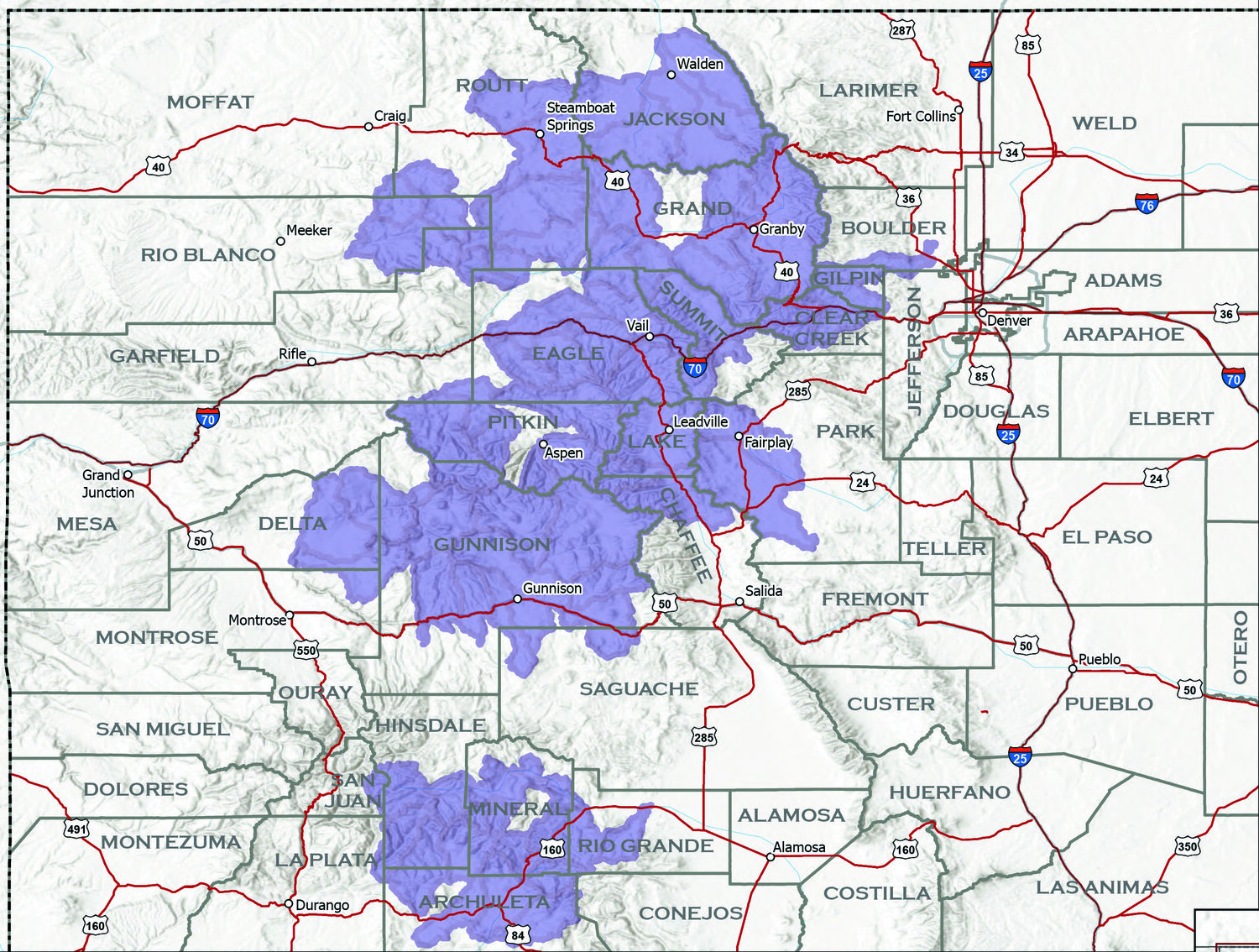
A lone female wolf made her way into Archuleta County between July 22 and Aug. 26, according to Colorado Parks and Wildlife’s (CPW’s) most recent wolf activity map released on Aug. 27.
The map shows watersheds where collared wolf activity is tracked, with the map noting, “Simply because a watershed indicates wolf activity, it does not mean that a wolf or wolves are present throughout the entire watershed.”
According to John Livingston, CPW Southwest Region public information officer, the wolf is a different lone female than the one previously tracked as entering northern Archuleta County as part of a large loop shortly before Mother’s Day.
That lone female was the first confirmed collared wolf activity in Archuleta County.
“The activity seen on this month’s map is from a different lone female, also one of the wolves released in January from British Columbia,” Livingston explains in an email to The SUN. “She has spent a great deal of time this summer near the Upper Rio Grande watershed after coming down from the Saguache area as she trickled down from areas to the north. She spent some time near the headwaters of the Rio Grande and just west of there.
“After spending several weeks in that general area, she eventually worked her way toward the Upper and Middle Piedra watersheds, which is why so much of the area is lit up on the map.”
Livingston noted that as the wolf made her way toward the Upper and Middle Piedra watersheds, CPW began making notifications to elected officials, local livestock producers and the La Plata-Archuleta Cattlemen’s Association.
“However,” he notes, “the wolf did not stay in that area long and continued moving east. She quickly was east of U.S. Highway 160 and out of Archuleta County. All of that movement took place in about a week’s time frame.”
He adds the wolf “has briefly touched watersheds in Mineral and Rio Grande Counties and her most recent location was in Rio Grande County, as highlighted on the map.”
Livingston explained that, per CPW’s memorandum of understanding with the Southern Ute Indian Tribe, CPW has also been providing regular reports to the tribe regarding this wolf’s activity.
The CPW website notes that wolves continue to make broad movements across many western counties.
Other notable updates from CPW regarding the wolves include:
• “A minimum count of six pups in the One Ear Pack was confirmed in Jackson County.”
• “CPW became aware of the mortality of female gray wolf 2304-OR in Wyoming and the Wyoming Game and Fish returned the wolf’s tracking collar. 2304-OR was part of the group of wolves translocated to Colorado from Oregon.”
• “CPW and USDA, Animal and Plant Health Inspection Service - Wildlife Services (WS) attempted to lethally remove a gray wolf in Rio Blanco County due to chronic depredation.”
The CPW website further states, “Our staff continues to monitor dens in Colorado and will include minimum counts of the entire wolf population in our annual biological year reports. Receiving reports of wolf sightings from the public, especially those accompanied by high-quality photos or videos, is extremely helpful to CPW as we monitor and track the movement of gray wolves. This will become increasingly important as the population of uncollared wolves grows through successful restoration and natural immigration into Colorado.”
“As always, we encourage anyone in the public that believes they have seen a wolf to report it to CPW through our wolf sightings page: https://cpw.state.co.us/wolf-sightings,” Livingston wrote.
The site also includes information on how to differentiate between wolves and coyotes.
Wolf reintroduction and living with wolves
Proposition 114, now Colorado Revised Statute 33-2-105.8, was approved by Colorado voters on Nov. 3, 2020, directing the Colorado Parks and Wildlife Commission to develop a plan to introduce and manage gray wolves in Colorado west of the Continental Divide.
Reintroduction began in 2023 with 10 wolves and has continued, including with 15 wolves that were translocated from the central interior of British Columbia to Colorado earlier this year, according to CPW.
For information on living with wolves, visit https://cpw.state.co.us/living-wolves.
Bill reallocates
reintroduction funding
Senate Bill 25B-005, introduced and passed during the recent extraordinary session of the Colorado General Assembly, reallocates Department of Natural Resources wolf funding to the Colorado health insurance enterprise.
The bill creates the health insurance affordability cash fund within the state treasury and directed the state treasurer to transfer $264,268 from the general fund to the new fund on Sept. 1.
The bill also repeals the subsection creating the fund effective July 1, 2026.
The same bill adds a subsection regarding the reintroduction of gray wolves on designated lands west of the Continental Divide and states that the parks and wildlife division “shall not use money appropriated from the general fund for state fiscal year 2025-26 for the purpose of acquiring or reintroducing gray wolves.”
It notes the division “may use money appropriated for state fiscal year 2025-26 for the purposes listed” in the subsection.
According to the bill, the subsection is repealed effective July 1, 2026.
Gov. Jared Polis signed the bill on Aug. 28.
randi@pagosasun.com


 >
>