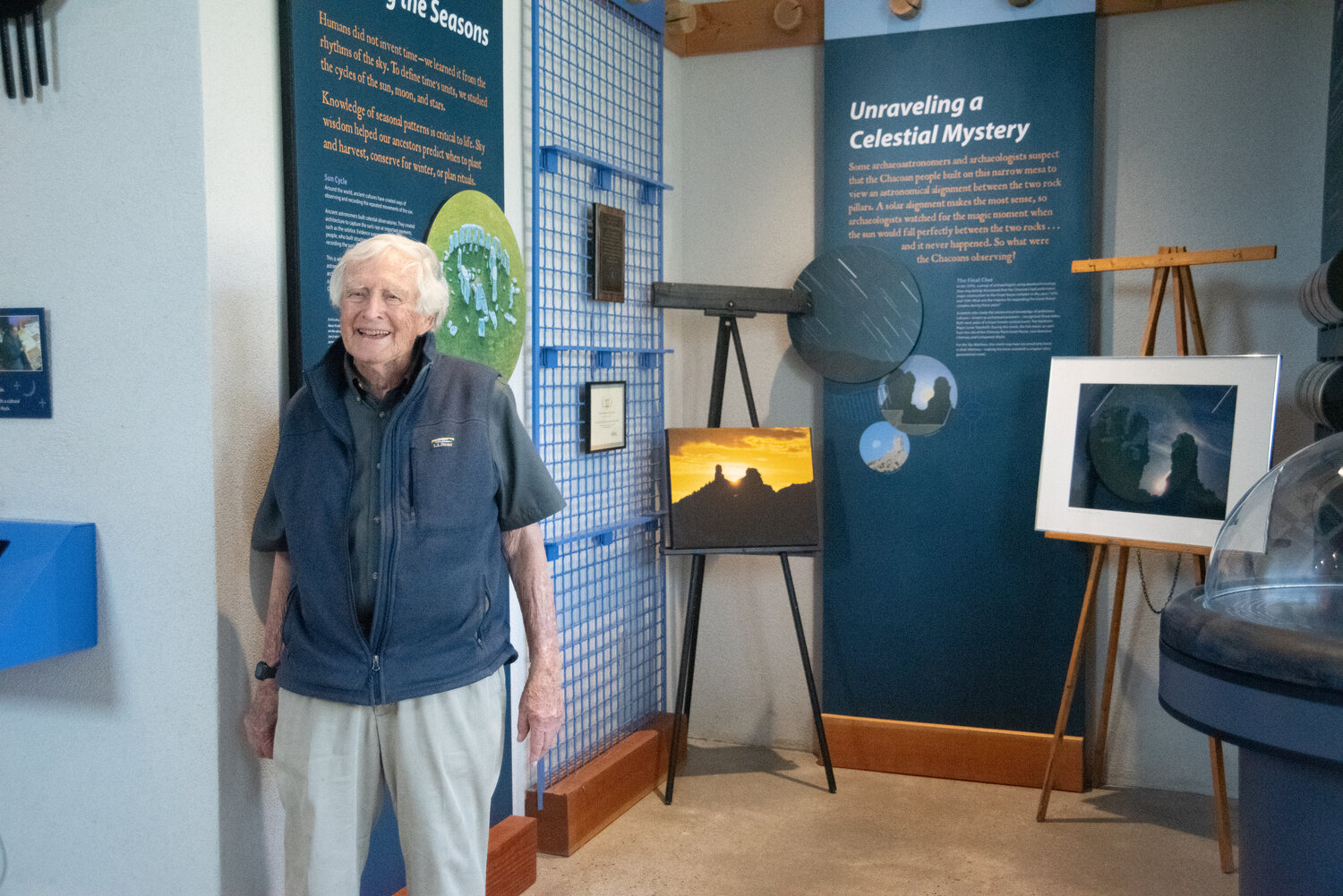
On Aug. 8, the Chimney Rock Interpretive Association (CRIA), along with family, friends, volunteers and representatives of the U.S. Forest Service, gathered at Chimney Rock National Monument to recognize a man whose curiosity and research helped reveal one of the site’s most fascinating connections to the night sky.
The gathering honored Dr. J. McKim Malville, professor emeritus of astrophysical and planetary sciences at the University of Colorado Boulder, and marked the 38th anniversary of his historic observation of the moon rising between Chimney Rock and Companion Rock during a major lunar standstill.
CRIA board president Jill Sutton welcomed those gathered for the special occasion, which included members of Malville’s family, CRIA volunteers, U.S. Forest Service representatives and others who came together to celebrate his contributions to the understanding of Chimney Rock.
As part of the recognition, a commemorative bronze plaque honoring Malville and his work is now displayed in the Chimney Rock Visitor Center.
Malville also donated something especially meaningful to the Visitor Center: a copy of the photograph he took on Aug. 8, 1988, capturing the moon rising between the two iconic pinnacles. The photograph provides a remarkable visual record of the observation that helped deepen our understanding of the relationship between Chimney Rock’s architecture and the movements of the moon.
A discovery 38 years in the making
Malville’s connection to Chimney Rock began with a question: Why was the Great House Pueblo constructed in such an extraordinary location?
The Great House sits high above the Piedra River Valley on a narrow mesa in the shadow of Chimney Rock and Companion Rock. Researchers had long recognized the site’s unusual characteristics, but Malville began exploring whether the placement of the Great House close to the pinnacles might have an astronomical connection.
He first considered alignments involving the summer solstice and Venus. Eventually, his attention turned to the moon and the major lunar standstill, an astronomical cycle occurring approximately every 18.6 years, when the moon reaches the northernmost extreme of its rising position along the horizon.
Malville discovered that the major lunar standstill periods in the late 11th century may have corresponded closely with construction activity at the Great House. That possibility led him back to Chimney Rock on Aug. 8, 1988, accompanied by four of his university students. After hours of anticipation, the moon began to rise between the pinnacles.
Rising into the space between Chimney and Companion Rock, the moon provided a dramatic confirmation of the astronomical alignment Malville had been investigating. His photograph of that moment became the first known photograph documenting a major lunar standstill moonrise between the pinnacles.
More significantly, Malville’s research provided compelling evidence that the Ancestral Puebloans who built and used the Great House understood this lunar cycle and intentionally chose this remarkable location to observe the moon’s movements between the pinnacles.
For Malville and his students, the experience was extraordinary. They were witnessing a phenomenon that may have held profound significance for the Ancestral Puebloans more than a thousand years earlier.
Preserving a legacy
Saturday’s gathering was more than the presentation of a plaque. It brought together people whose connections to Chimney Rock span research, preservation, interpretation, volunteerism and family.
Remarks by Ron Sutcliffe and Susan Yalom helped reflect on Malville’s work and the importance of his contributions, while the presence of his family added a personal dimension to a story that has become an important part of Chimney Rock’s modern history.
Now, visitors to the Chimney Rock Visitor Center will be able to see both the plaque recognizing Malville and the photograph documenting that remarkable August morning in 1988.
Together, they tell the story of scientific curiosity, careful observation and a landscape that continues to reveal connections between the earth and sky.
For Chimney Rock, the story is particularly fitting. For centuries, the two pinnacles have stood above the Piedra River Valley while the sun, moon and stars moved across the sky. Malville’s work helped modern observers look at that familiar landscape differently — and consider what those same movements may have meant to the people who came before us.
Thirty-eight years after he stood on the mesa and watched the moon rise between the pinnacles, Malville returned to Chimney Rock to see that discovery recognized and preserved for generations of visitors yet to come.


 >
>