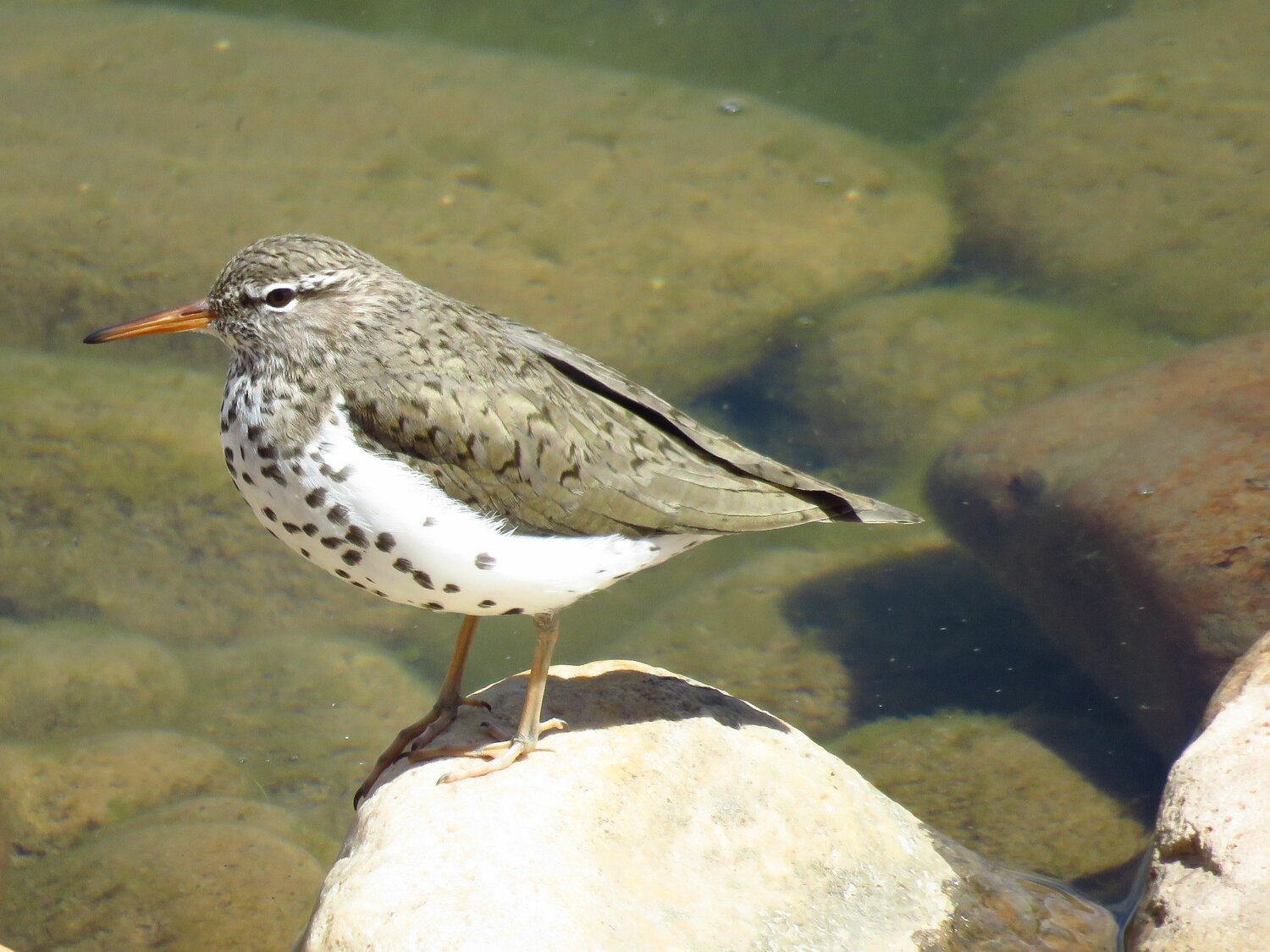
This week’s Bird of the Week, compliments of the Weminuche Audubon Society and Audubon Rockies, is the spotted sandpiper.
Among the shorebird group of birds that is often difficult to identify, the spotted sandpiper with its characteristic behaviors and plumage is one relatively easy to pick out. While most sandpipers breed only in far northern reaches, in summer this one raises young in more places in North America than any other one. They occur at rocky edges of streams, rivers, ponds, and lakes from low to high elevations throughout Canada and most of the United States.
A teetering gait with nearly constant bobbing of the rear end are distinctive movements of this bird. Soon after hatching, even chicks teeter and bob. Spotted sandpipers are active foragers, walking and pecking along the shoreline in search of small invertebrates or small fish. They probe into the sand or mud with long bills, lunge at moving prey, pick insects off plants and snap at airborne ones.
During breeding season, this medium-sized shorebird has dark spots on a bright white chest and an orange bill. As it molts out of breeding plumage, it gradually loses its dark spots. When disturbed, after calling a few high whistled notes, it flies off low over the water with bursts of fast wingbeats interspersed with brief glides.
In an uncommon reversal of roles between the sexes, females arrive first on the breeding grounds, establish a breeding territory and vigorously defend it against other females. Nesting territory must include a shoreline, a semi-open area for the nest and patches of dense vegetation for sheltering the chicks.
Females focus on egg laying and males on child rearing. Over the six- to seven-week breeding season, a female may court and mate with up to four males. At other times a monogamous relationship occurs. Males have more of the hormone that promotes parental care and they are the ones that incubate the eggs and care for the young.
Spotted sandpipers winter in extreme southern parts of the United States and throughout Central and South America. Although last year one was still around for the Christmas Bird Count, they are usually only found in our area from mid-April into early October. They are still common and widespread, but population numbers are experiencing steep declines.
For information on events, visit www.weminucheaudubon.org and www.facebook.com/weminucheaudubon/.


 >
>