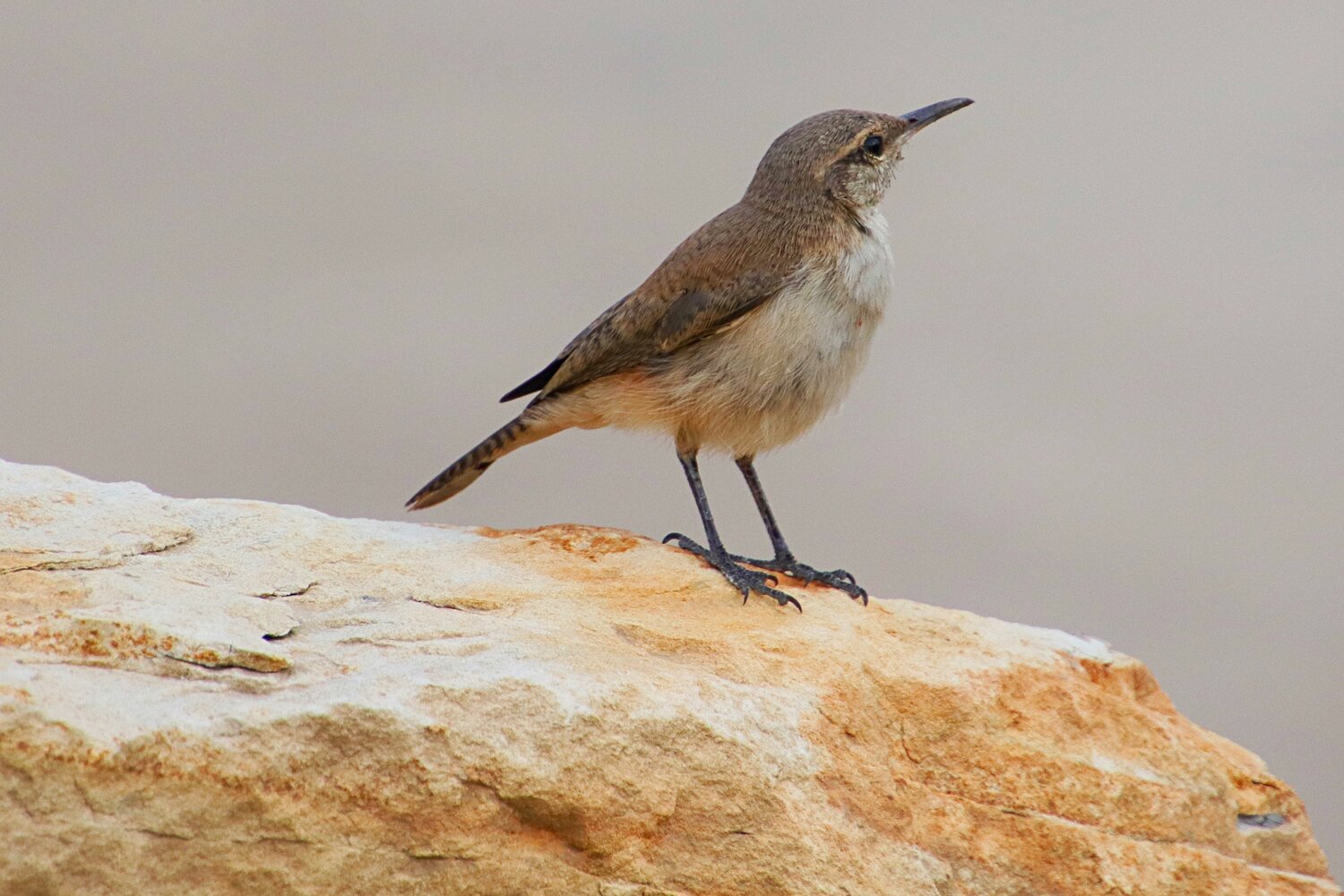
This week’s Bird of the Week, compliments of the Weminuche Audubon Society and Audubon Rockies, is the rock wren.
Like that aquatic songbird the American dipper, the rock wren is often seen bouncing up and down on a rock, but there the similarity ends. The rock wren is a bird of dry, rocky habitats from deserts to alpine mountaintops of western North America. Its breeding range extends from southern Canada down through Mexico and Central America, where it is a resident bird.
The rock wren is colored to blend into the grayish-brown landscapes that it occupies. Its finely speckled back and wings are pale brown, and its undersides are whitish with a slight peachy wash. It has a pale eyebrow stripe. The canyon wren is rustier brown, and the more common northern house wren lacks the eyebrow stripe and speckling of the rock wren.
The rock wren hops from rock to rock and uses its long, delicate bill to probe crevices for food. It mainly eats ground-dwelling insects and spiders along with some seeds and other plant matter. Even when it is available, this wren is not known to drink water.
Male rock wrens sing a large number of variations of their cheery song, often from a prominent rock perch overlooking their territory. Their genus name, salpinctes, comes from the Greek word for trumpeter. They are territorial and guard their female mate, driving out rivals by calling or flying at and grappling with them.
These birds most often nest out of sight in rock crevices, where they build a woven nest on top of a foundation of tiny stones or sticks. An interesting feature added is a porch or a walkway of small flat stones that leads into the nest. Adults may stack small rocks at the entrance to protect it from predators by reducing the size of the opening.
Appropriately, these birds are known to nest at Chimney Rock National Monument.
For information on events, visit www.weminucheaudubon.org and www.facebook.com/weminucheaudubon/.


 >
>