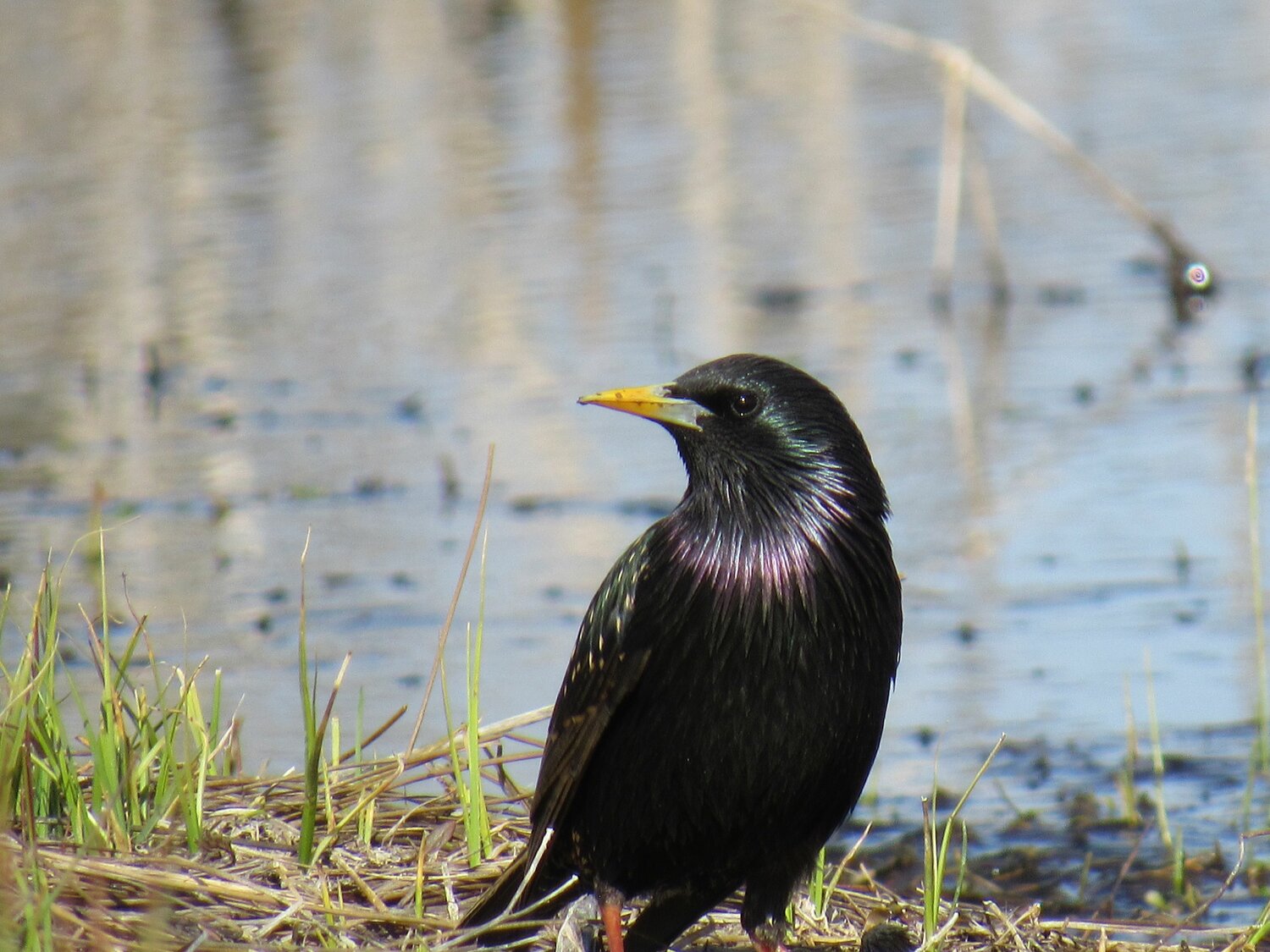
This week’s Bird of the Week, compliments of the Weminuche Audubon Society and Audubon Rockies, is the European starling.
Prior to the 1890s releases in New York of around 100 starlings imported from Europe, these birds did not inhabit North America. A look at the current range map shows just how successful they have been at colonizing the United States and Canada where many now live year-round. They are counted among the continent’s most numerous songbirds. Starlings typically live around people, and their simple habitat requirements are easily met in towns. To forage they need open grassy areas of short vegetation like those found in parks, in lawns and in fields. They need water to drink and bathe, and tree cavities or crevices in buildings for nesting.
European starlings eat nearly anything. On the grass, they poke their closed bills into the earth and capture insects and other invertebrates with the use of strong jaw muscles that force the bill open. They also eat wild and cultivated fruits, grains, seeds, nectar and livestock feed, and pick through our garbage for food scraps. During breeding season they are extremely aggressive birds that drive other cavity nesters away from desirable nest sites. Outside this time of year they are gregarious birds that feed and perch together in flocks.
They are admired for their ability to fly together in huge groups in hypnotic, swirling, shape-shifting clouds of birds known as murmurations. During these flights, each starling responds to the flights of six or seven of its nearest neighbors to change direction and position in the flock.
Starlings are admired for their vocal abilities. Their songs are composed from loud whistles and softer warbling. They communicate with each other using several different calls to indicate danger, location and their state of aggression. They are skilled mimics that imitate the songs of other birds, sounds like car alarms and human speech.
Lastly, these chunky, short-tailed birds are admired for their beauty, which changes with the seasons. In breeding plumage their feathers show purplish-green iridescence and their dark bills turn orange. In fall, newly grown feathers have white tips, which give winter birds a spotted appearance.
Despite the starling’s adaptability, populations are now in steep decline both in North America and in Europe.
For information on events, visit www.weminucheaudubon.org and www.facebook.com/weminucheaudubon/.
Photo courtesy Charles Martinez


 >
>