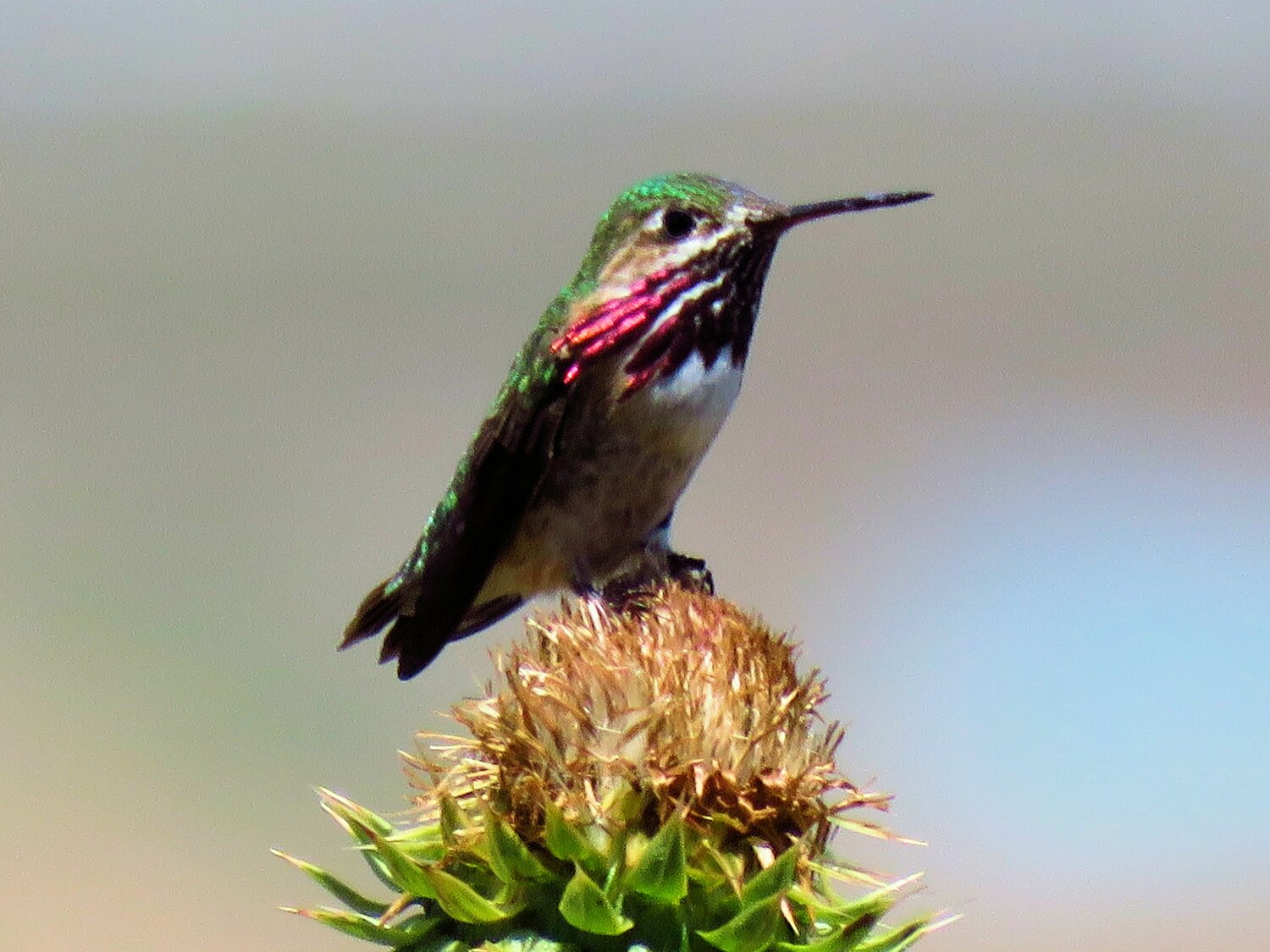
This week’s Bird of the Week, compliments of the Weminuche Audubon Society and Audubon Rockies, is the calliope hummingbird.
At this time of year, the smallest bird in the United States and Canada stops to rest and refuel in our area. Measuring less than 3.5 inches, and at one-tenth ounce weighing as much as a ping-pong ball, it is also recognized as the smallest long-distance migratory bird in the world. Everything about this bird, including tail, wings and thin bill, is short.
Following flower bloom times, a calliope hummingbird may migrate more than 5,000 miles each year from winter grounds in pine/oak forests of Mexico to western breeding grounds and back. In the spring they migrate north along the Pacific Coast to breed in cool mountain meadows, willow/alder thickets, or forests recovering from fire or logging between 4,000 and 11,000 feet of elevation. Their summer range stretches from California north to British Columbia and east to Wyoming.
The calliope breeds at higher elevations than many other hummingbirds. To survive nighttime drops in temperature, it may enter a state of torpor, lowering its body temperature and metabolic rate to conserve energy. As is typical with hummingbirds, no lasting pair bond is formed between partners. Although the male defends his breeding territory against birds as large as a red-tailed hawk, he provides no parental care.
The female builds a tiny nest on an evergreen branch sheltered from above that can look like a pine cone. She lays two white eggs about the size of a coffee bean and is responsible for incubating, feeding the young and keeping them warm at night until they are on their own.
Until genetic testing placed the calliope in the same genus as rufous and broad-tailed hummingbirds, it was in its own genus, Stellula, which means little star. This was a reference to the male calliope’s iridescent magenta gorget, which is divided into separate rays like a burst of starlight. Females and immature males have a white throat marked with a few small dark spots and a peachy wash across the breast.
Calliope hummingbirds that we see here are returning by an inland migratory path along the Rocky Mountains back to Mexico, a remarkable journey for this tiny bird.
For information on events, visit www.weminucheaudubon.org and www.facebook.com/weminucheaudubon/.
Photo courtesy Charles Martinez


 >
>