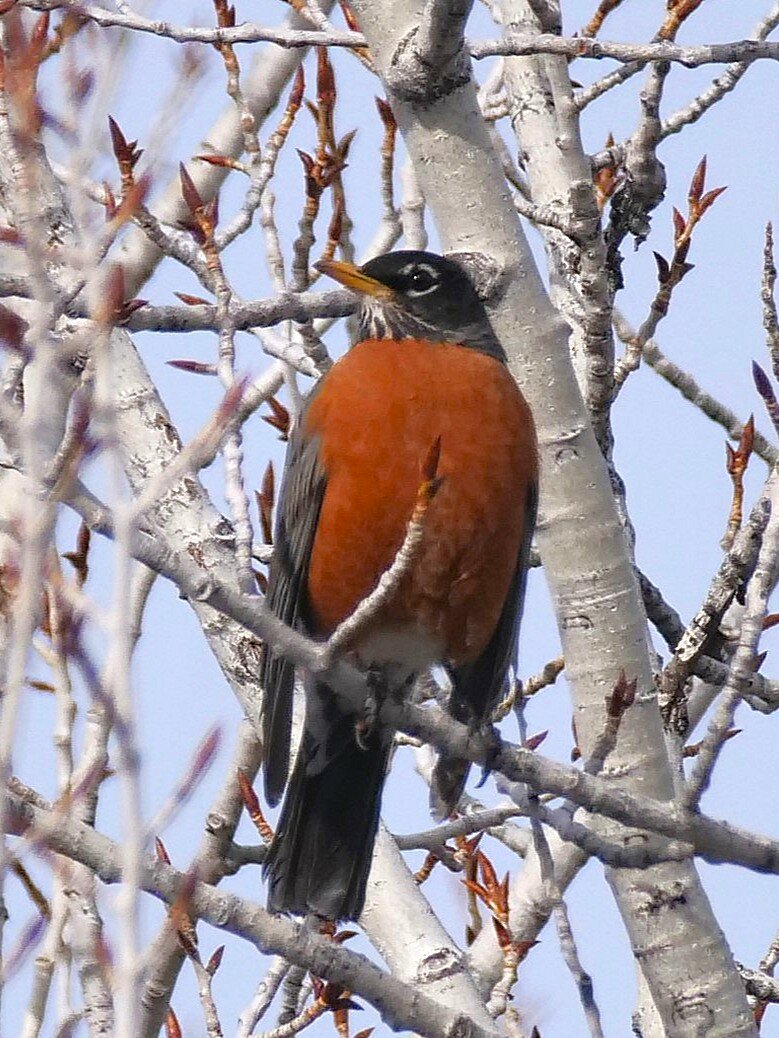
This week’s Bird of the Week, compliments of the Weminuche Audubon Society and Audubon Rockies, is the American robin.
We think of these birds as a sign of spring, but, in fact, American robins live near us year-round. Its scientific name may be Turdus migratorius, but the robin is a resident bird in most of the United States.
Rather than migrate, here these common birds change habitat types with the seasons. They are more visible in our yards in spring, showing up when the ground is wet to hunt earthworms. Watch a robin on the lawn and you will see it run a few steps, and then stop abruptly with head cocked, listening. Experiments have demonstrated that the robin locates a worm by hearing it underground. They also eat insects and snails, which they locate by sight.
When worms and insects are less available, we find robins in wooded areas looking for fruits and berries, including those of chokecherries, hawthorns, dogwoods, sumacs and junipers. The robin’s diet varies not only with the season, but also with the time of day. Later in the day they are likely feeding on fruits and berries, but in the morning they live by the proverb that “the early bird gets the worm.” Well before sunrise the robin may begin to sing its musical song, and it is also often the last song heard as night falls.
The American robin is so familiar that it is often the first bird that children learn to identify. Its size is used as a comparison to talk about the appearance of other birds. Its reddish breast, dark back, white arcs around the eyes and yellow bill make it easily identifiable.
By all appearances, there is nothing that an American robin likes better than taking a bath. Bathing helps birds cool down during heat waves like we have been experiencing. Unable to sweat, some birds pant with mouths open as a means of evaporative heat loss and need to replace the water lost by drinking. Birds like herons, nightjars and turkeys practice gular fluttering, rapid open mouth breathing with quick vibrations of the moist throat membranes as a way to transfer heat.
You can help birds and the other critters that visit your living space by providing the cool, clean water they need to survive.
For information on events, visit www.weminucheaudubon.org and www.facebook.com/weminucheaudubon/.
Photo courtesy Jeffrey Reichel


 >
>