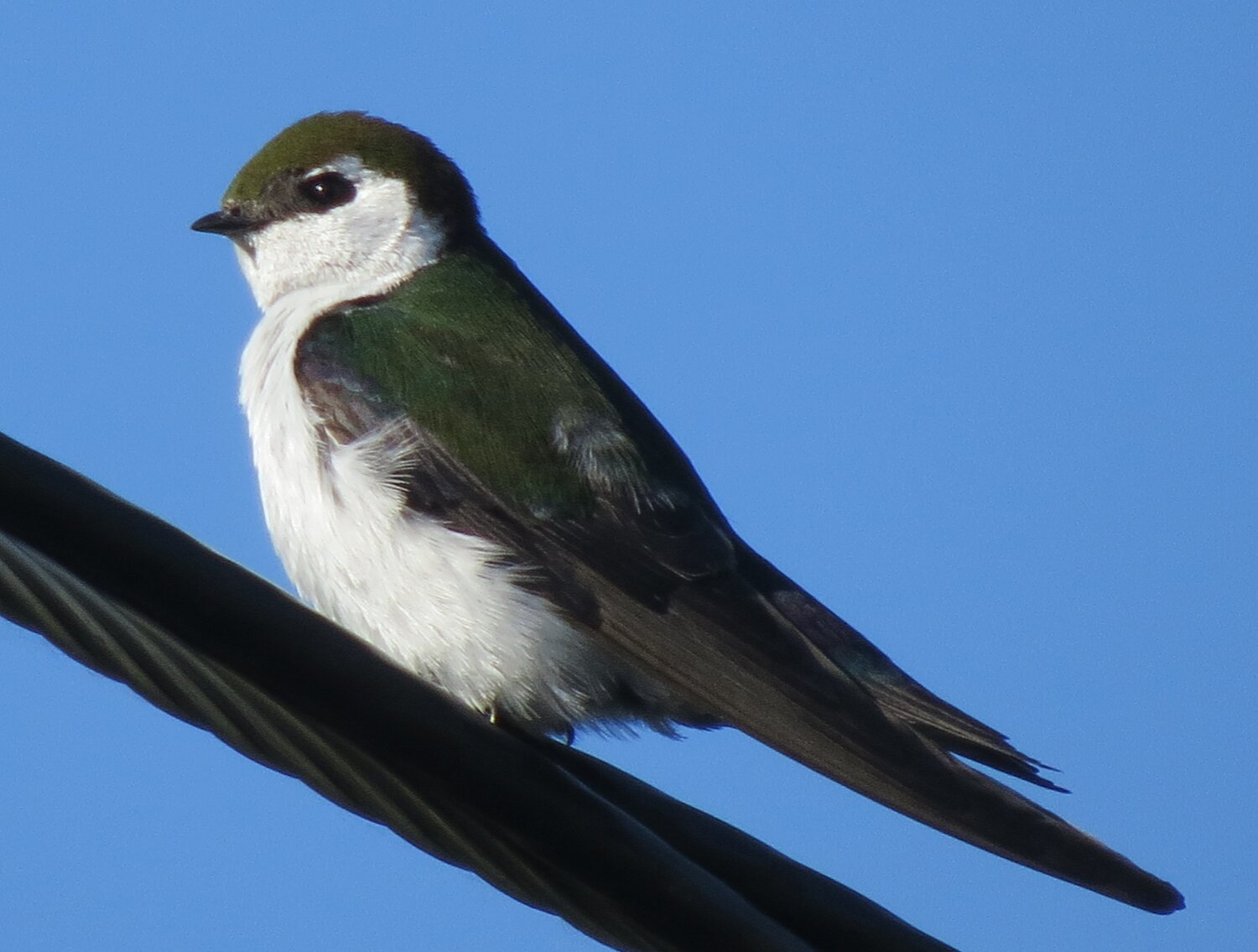
This week’s Bird of the Week, compliments of the Weminuche Audubon Society and Audubon Rockies, is the violet-green swallow.
With rapid, shallow wingbeats interspersed with long glides, violet-green swallows patrol our summer skies in search of insects. They forage low over water and fields or high in the sky to feed on a variety of winged insects including flies, bees, beetles, moths and winged ants. Swooping and twittering, they can fly at speeds up to 28 mph.
The violet-green is very similar in appearance and habits to the related tree swallow. Both show a white belly in flight, but violet-greens display white patches on either side of the rump and white cheeks. Sunlight illuminates the metallic green back and iridescent purple rump for which this swallow is named. When not in flight, groups will line up on power lines and dead tree limbs to preen and sunbathe as a means to control parasites.
Across the western United States, violet-green swallows breed in open deciduous and evergreen forests in elevations from sea level to above 11,000 feet. They are secondary cavity nesters that depend on using old woodpecker holes or other natural cavities for nest sites. They are gregarious all year, often like to nest in small groups, and will use nest boxes. One pair was documented helping western bluebirds raise their nestlings and then moving into the nestbox after the bluebirds left.
Across much of North America and Europe, aerial insectivores like this swallow are experiencing population declines from neonicotinoids, climate change and pollution, which kill insects. In the fall of 2020, violet-green swallows were counted among the thousands of migrating songbirds that died in New Mexico, Colorado, Texas and Arizona. Many of these birds were severely emaciated without the fat stores required to survive migratory journeys.
Smoke from wildfires in California which caused birds to migrate early or change their paths to detour around it was thought to be a contributing factor to this massive die-off. Birds are even more sensitive than us to pollutants in the air and can suffer damage to lung tissue from the dangerous levels of fine particulate matter and hazardous chemicals in wildfire smoke.
For information on events, visit www.weminucheaudubon.org and www.facebook.com/weminucheaudubon/.


 >
>