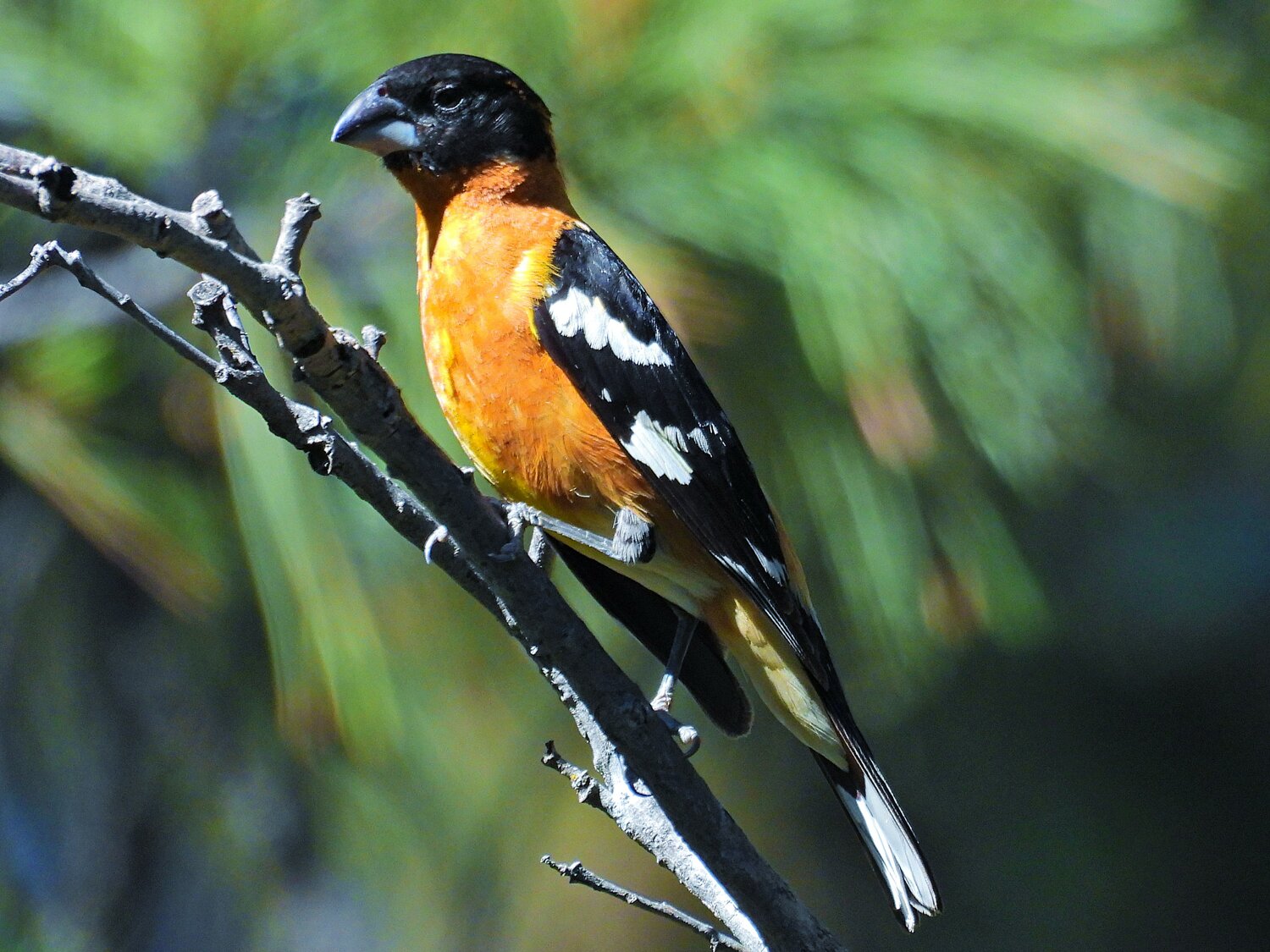
This week’s Bird of the Week, compliments of the Weminuche Audubon Society and Audubon Rockies, is the black-headed grosbeak.
It’s baby season for many of our songbirds. It’s time for young birds to leave the nest and learn to survive on their own. In the woods, in places near water and in our backyards, the begging cries of hungry birds can be heard. Interspersed with the hard-to-ignore, loud calls of magpies, jays, Lewis’s and flickers are the soft whining whistles of young black-headed grosbeaks waiting to be fed.
With his spring arrival from Mexico, the male black-headed grosbeak brings his long, sweet song that is a favorite of many who tune into the music of birdsong. Both males and females sing, even while on the nest. Female song is typically a simpler version of the male’s. It is believed that song between the parents functions to keep the family group together after young have fledged, and once the young are fully independent, song ceases.
Along with other colorful birds including tanagers, northern cardinals, pyrrhuloxia, blue grosbeaks, and indigo and lazuli buntings, black-headed grosbeaks are members of the cardinal bird family. Adult males have a black head, orange underparts and black wings with white patches. Females and immatures are brown and streaky above with orangish undersides and a striped head. Male birds do not achieve breeding plumage until 2 years of age and until then resemble females.
With their massive conical bills, these grosbeaks are able to crack seeds and crush hard-bodied insects and snails. They also eat wild and cultivated fruits and berries, and readily come to feeders for sunflower seeds. During winter in Mexico they are one of the few predators of Monarch butterflies, whose toxins in their milkweed diet make them poisonous to most birds.
Black-headed grosbeaks breed in habitats with a combination of large trees and a diverse understory and access to water. Their summer range includes western states, southwestern Canada and the parts of Mexico, where they are resident birds. Males and females share equally in the parental roles of incubation and feeding of young.
Among the perils that baby birds face is the presence of domestic cats, which in the U.S. kill an estimated 2.4 billion birds per year. Keeping cats indoors is better for them and better for wildlife.
For information on events, visit www.weminucheaudubon.org and www.facebook.com/weminucheaudubon/.
Photo courtesy Charles Martinez


 >
>