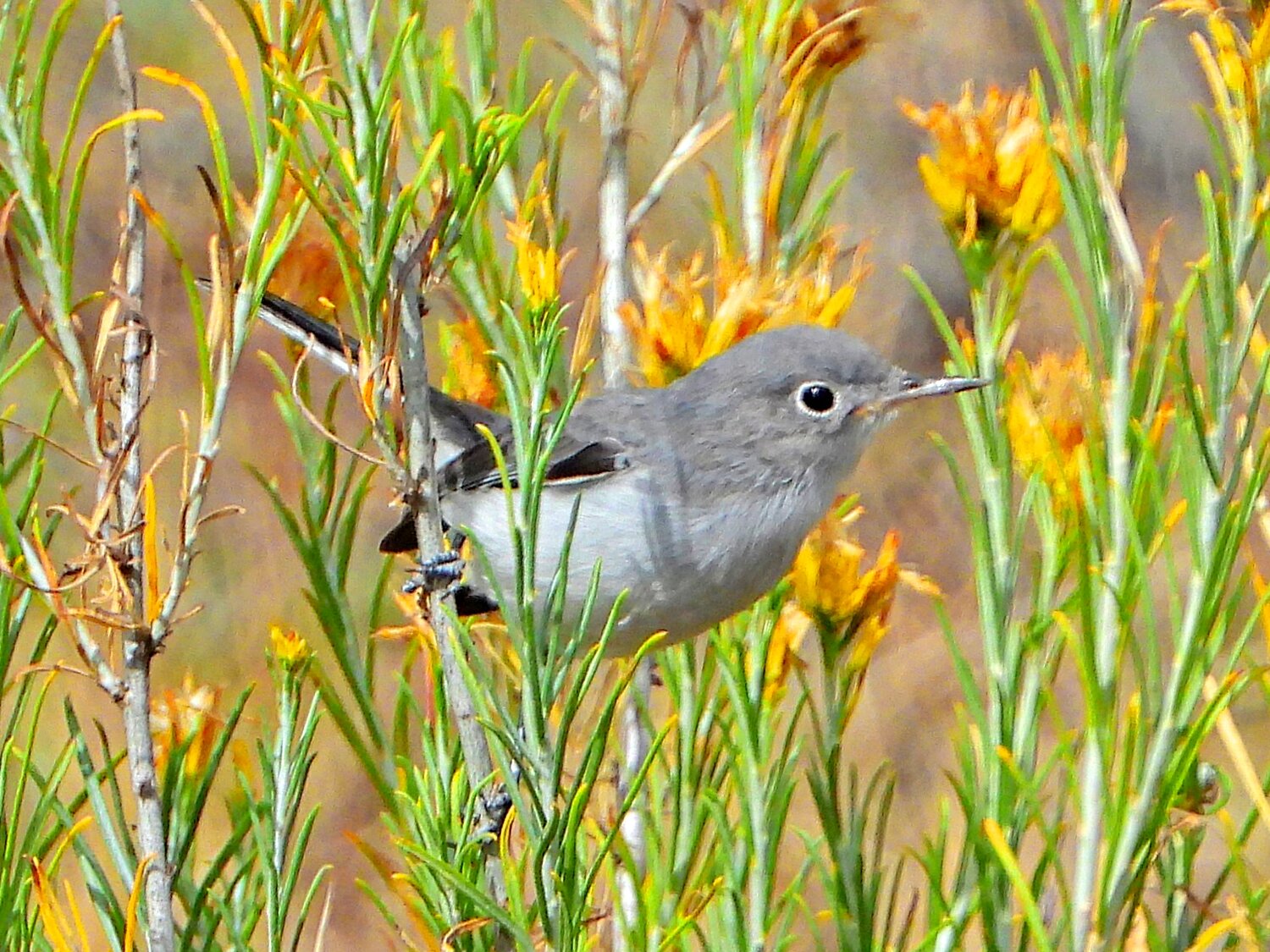
This week’s Bird of the Week, compliments of the Weminuche Audubon Society and Audubon Rockies, is the blue-gray gnatcatcher.
One of the earliest songbirds to arrive in summer breeding territories is this tiny, long-tailed gnatcatcher. While most members of its genus are resident birds in Central and South America, the blue-gray breeds across eastern and southwestern parts of the United States and into Mexico. Of the 18 species of gnatcatchers, it is the one that ranges farthest north and is the most migratory.
The forest composition of its breeding range varies with the region. In the west, they nest in scrubby habitat, preferring moist areas near forest edges. They are found in oak and pinon-juniper woodlands and in areas of willows and cottonwoods.
While flicking their white-edged tails side to side to flush prey, these busy birds forage in constant motion, often out of sight within the foliage. They hunt by scouring branches and leaves while perched or hovering, and will sally out to nab an insect flying by. They eat small insects, spiders and other invertebrates whole. Larger prey are consumed after first removing the wings and beating them against a branch. Sadly for us, despite their name, gnats do not form a significant part of their diet.
These tiny, slim birds sing a wren-like song, often while mimicking the voices of other birds. Their soft, insistent “pzzzz” contact calls sound like they are whispering secrets to each other as they dart about. Breeding males are colored blue-gray above and white underneath, have a black V over their eyes and a white eyering. Females and nonbreeding males are not as blue.
On their breeding territory, males are fiercely territorial, defending their space with vocal and posture displays. If these don’t work, birds may fly up and snap at each other midair. With other small birds, they will mob potential predators. Pairs may build up to seven nests in a season to combat the frequent nest failures they experience from predation, mites and parasitism by cowbirds.
Along with warming temperatures, since the early 20th century the nesting range of the blue-gray gnatcatcher has shifted northward and their populations have increased.
For information on events, visit www.weminucheaudubon.org and www.facebook.com/weminucheaudubon/.
Photo courtesy Charles Martinez


 >
>