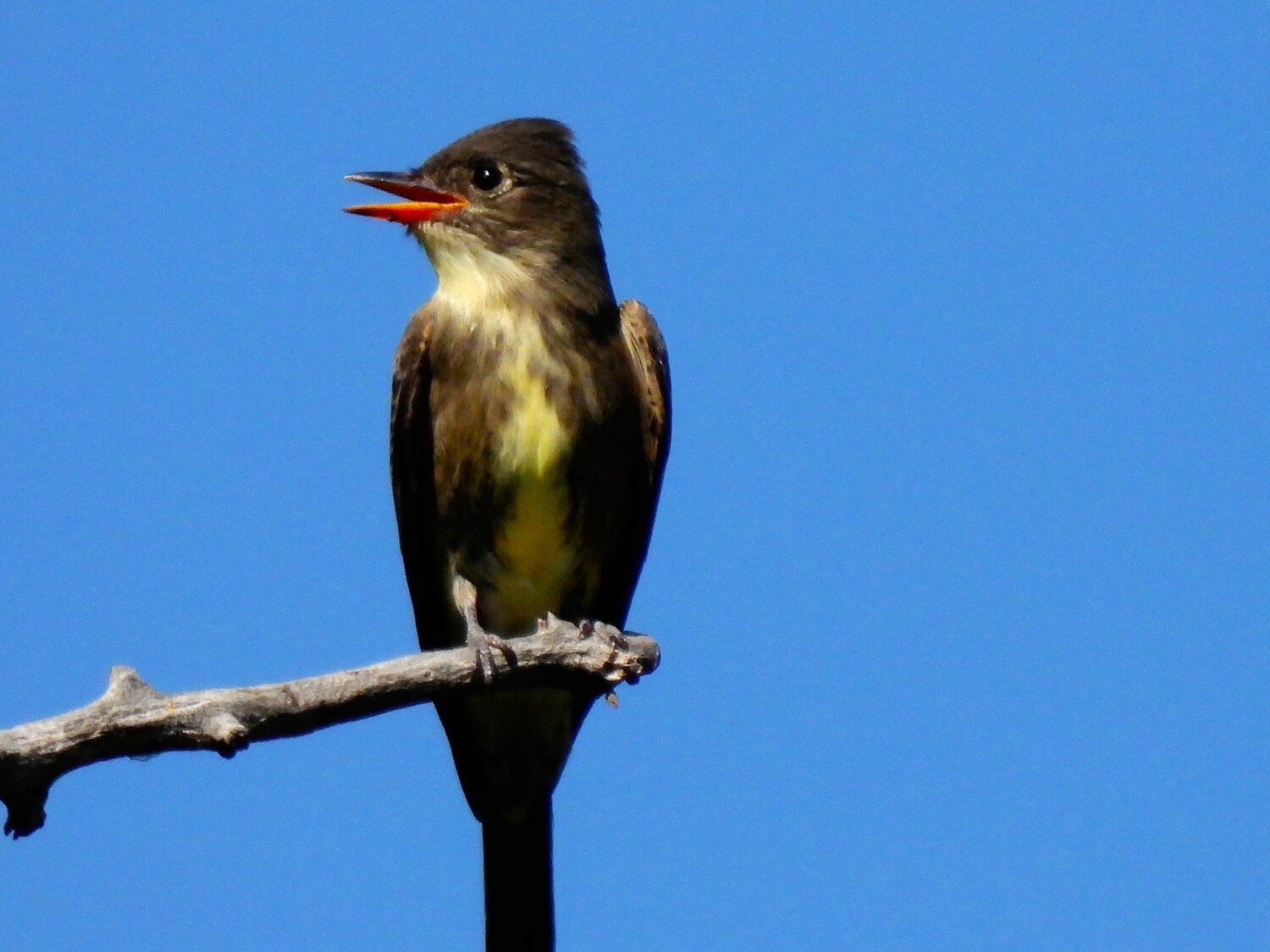
This week’s Bird of the Week, compliments of the Weminuche Audubon Society and Audubon Rockies, is the olive-sided flycatcher.
Birds that are members of the flycatcher family arrive in May to spend the summer here raising young and feasting on insects. Of the more than 400 species in this bird family, only about 35 of them are typically found in the U.S. and Canada. These are divided into three groups: the large and assertive kingbirds, the medium-sized crested group which nest in tree cavities and the small-sized grayish or greenish forest-dwelling ones.
The olive-sided is included in this last group, whose members can be visually hard to tell apart. Of these, it is one of the larger, and is stocky in appearance with a large head and relatively heavy, long bill. The dark gray sides of its breast are divided by white in the center, looking almost like it’s wearing a vest.
The best clues that identify this bird as an olive-sided are its habit of sitting bolt upright on the top of the highest dead branch of a tree and its easily recognizable song. Early field guides translated the distinctive three-part song as “quick, three beers,” which we remember when hearing the bird today.
This flycatcher is a long-distance migrant that winters in South America, through Central America and into Mexico. Some migrate up to 7,000 miles to breed in Alaska, with others stopping in the boreal zones of Canada and in the western mountains of the U.S. For nesting they prefer habitat in forest edges or openings with wet meadows, beaver ponds, bogs and muskegs. These provide dead or dying trees with exposed perches and an abundance of aerial insects.
The olive-sided flycatcher seems to benefit from natural disturbances and occurs at higher numbers in burned over unburned areas. They may respond positively to logging as long as some trees and snags remain. From a high perch, they watch for aerial insects, which they fly out to catch and return to the perch to eat. They subsist almost entirely on flying insects, a large percentage of which are wasps, bees, and winged ants.
Shockingly they have experienced a population loss of 78 percent since 1970. According to Partners in Flight, these steep losses “parallel declines in other aerial insectivores such as swifts, swallows, and nightjars.”
For information on events, visit www.weminucheaudubon.org and www.facebook.com/weminucheaudubon/.
Photo courtesy Charles Martinez


 >
>