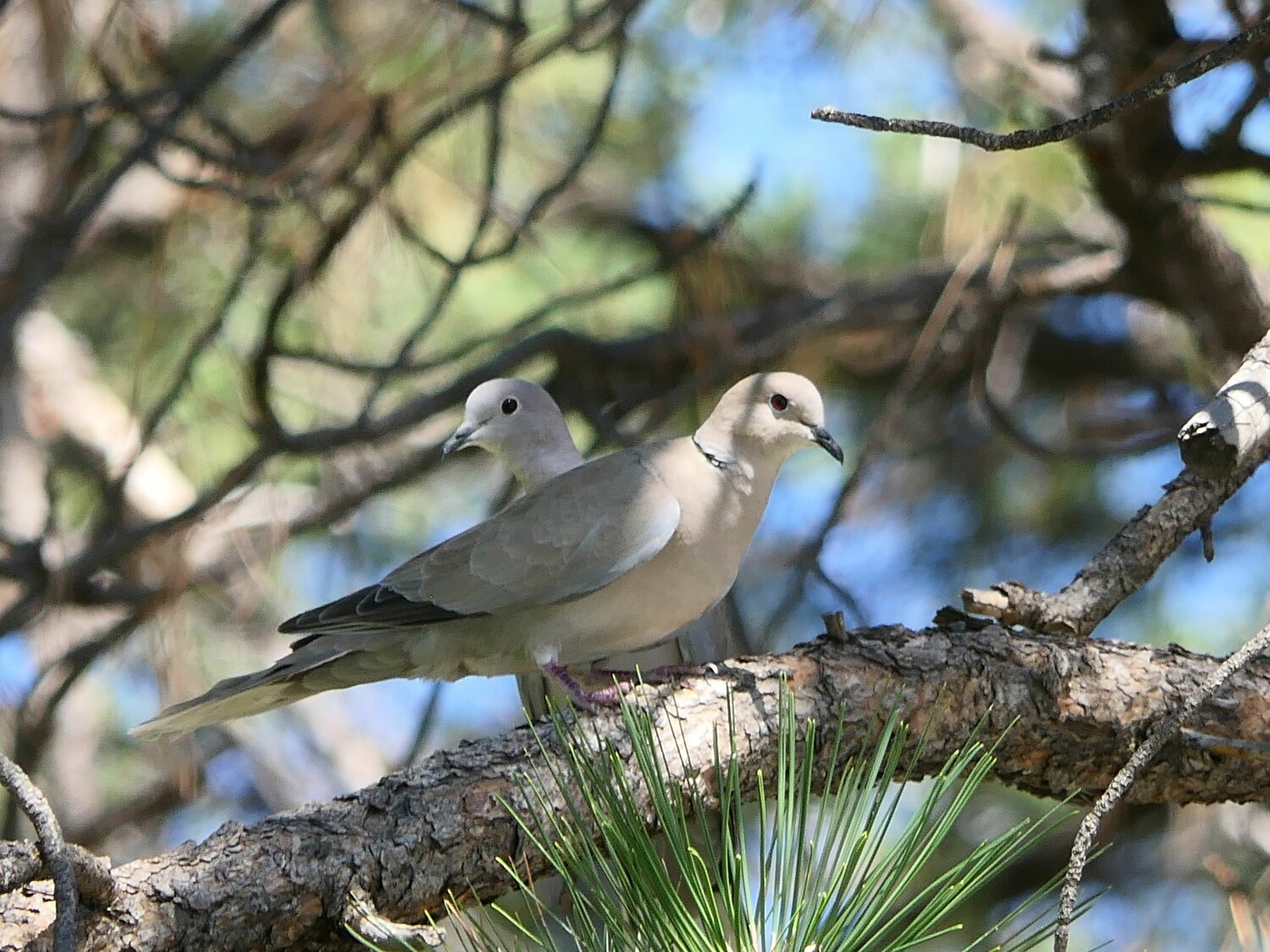
This week’s Bird of the Week, compliments of the Weminuche Audubon Society and Audubon Rockies, is the Eurasian collared-dove.
As its name would suggest, this bird is not native to North America, but today it is a resident bird across most of the United States. The ancestors of today’s Eurasian collared-doves in North America were introduced to the Bahamas in the 1970s as part of the pet trade. After a few escaped from a pet shop during a burglary, the owner released the rest of the flock of 50 and, by the 1980s, some had made their way to Florida. By 1996, Eurasian collared-doves were being seen in Colorado, where today they are common.
People have contributed to the phenomenal range spread of these birds by providing bird feeders and by planting trees nearby for roosting and nesting in urban areas. They primarily are ground feeders, but will come to platform feeders. In urban areas, bread crumbs tossed by people are a significant part of their diet. They also thrive in agricultural areas that provide the seeds and cereal grains that they eat, but are not as likely to be found in the forest.
Eurasian collared-doves make excellent parents. After a male attracts a partner with his incessant calling and impressive flight displays, he shows her potential nest sites and provides the sticks to build a simple platform in a tree or on a building. Both parents incubate the eggs and provide food to the nestlings. Rather than providing chicks with insects, parents produce a fat and protein-rich crop milk to feed the nestlings for the first five to 10 days. Typically, the female lays only one or two eggs, but, in warm climates, a pair may raise up to six broods per year.
The fairly large Eurasian collared-dove is mostly sandy brown, has a small head, long square-tipped tail and a black crescent on the back of its neck. The related mourning dove is smaller, has black spots on its back, a pointed tail and lacks a black collar. The collared-dove is readily spotted in town with groups perched in a tree or on a wire, singing their repeated, three-parted coo.
So far, the spread of these non-native doves has not demonstrated a negative impact on our native birds.
For information on events, visit www.weminucheaudubon.org and www.facebook.com/weminucheaudubon/.
Photo courtesy Charles Martinez


 >
>