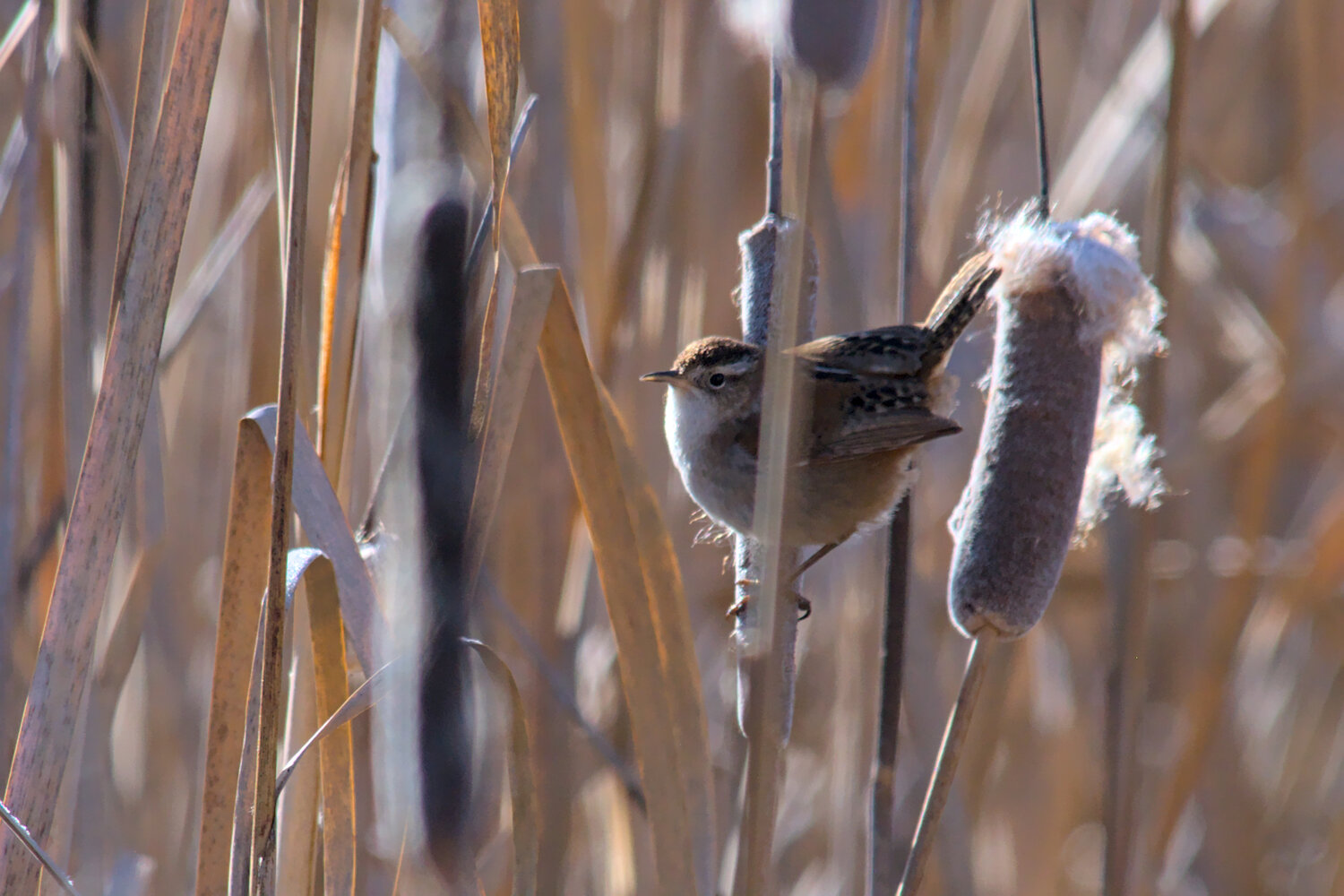
This week’s Bird of the Week, compliments of the Weminuche Audubon Society and Audubon Rockies, is the marsh wren.
With more than 80 species worldwide, wrens are active, reclusive, curious birds more easily heard than seen and whose songs seem impossibly loud to be coming from such a small bird. Wrens are colored to blend in rather than stand out. The tiny, round-bodied marsh wren is no exception, having a brown back with black and white streaks, pale unstreaked underparts, and dark barring on its short tail. It has a pale eyebrow and unmarked shoulders.
Wrens occupy a variety of habitat types and where you are is the first clue to which wren you may find. The marsh wren is known as the wren of the cattail marsh, but it also occupies other fresh and saltwater marshes with dense stands of tall wetland plants. Sometimes movement of the plants rather than the bird itself is all you may see.
Come spring, the male marsh wren pops up out of hiding to sing his territorial songs. Often with legs splayed and each foot wrapped around a different stalk, he throws his head back and cocks his tail up as he sings one of the variations of the many songs he has learned. He sings while darting to and fro within the cattails and while in low flight above the marsh.
A bird’s choice of habitat influences the song it sings. Songs of a treetop singer are often comprised of sharp, clear, high-pitched notes that travel better in open air. Male marsh wrens sing a series of gurgling, buzzy trills at a staccato sewing machine pace that travel further in dense vegetation.
In spring, when he’s not busy singing, deep within the vegetation the male weaves at least six and as many as 20 nests to show off to potential mates. The finished nest is a coconut-shaped ball with a hollowed-out interior and small side entrance which the female finishes by adding grasses, down and feathers.
Marsh wrens are competitive birds known to destroy the eggs and even nestlings of other marshland denizens, including those of birds much larger than itself. Upon hearing the song of the marsh wren, red-winged blackbirds sound the alarm and launch aerial attacks against its fierce neighbor.


 >
>