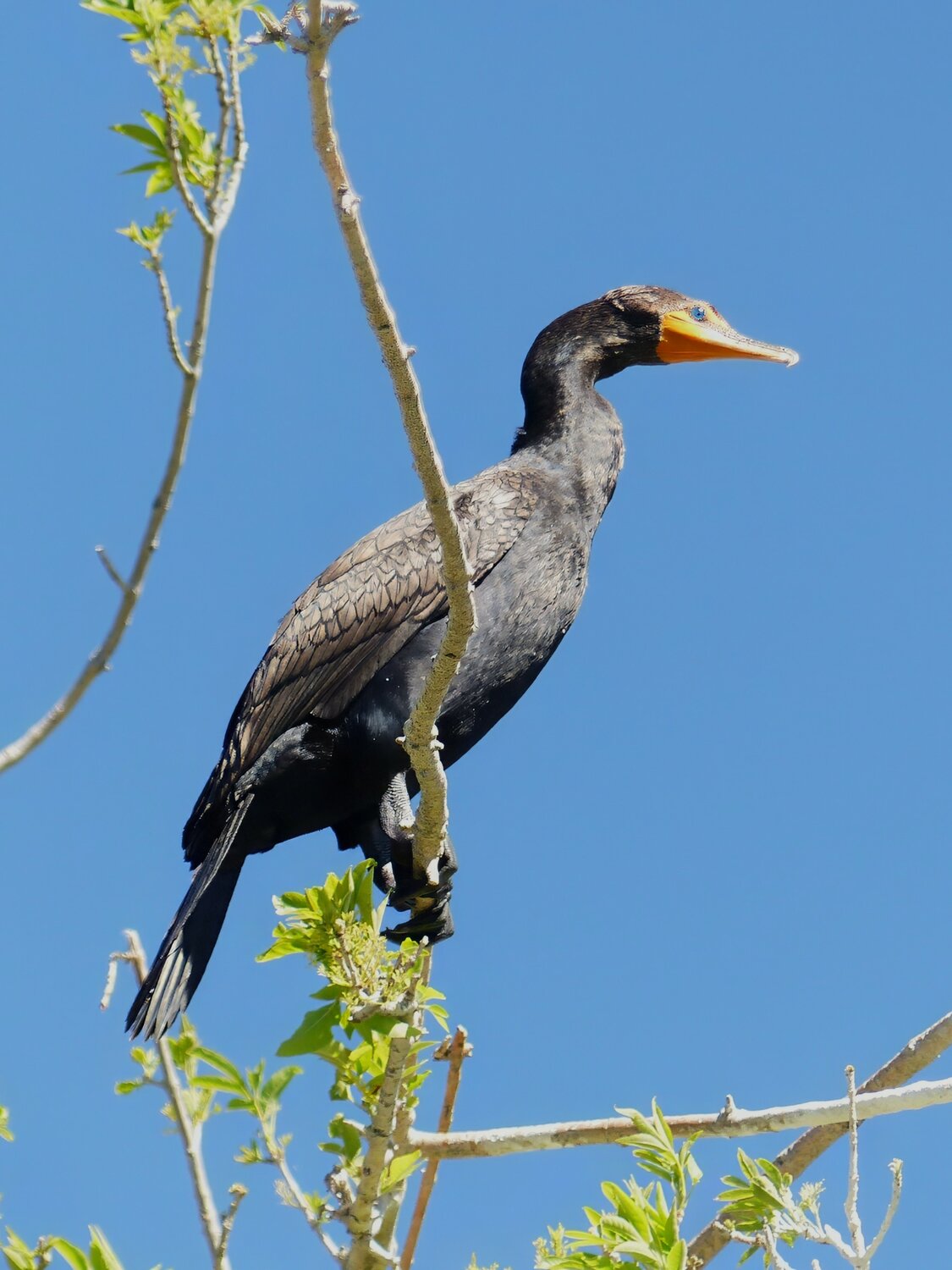
This week’s Bird of the Week, compliments of the Weminuche Audubon Society and Audubon Rockies, is the double-crested cormorant.
These birds are another type of waterbird whose ability to remove excess salt from the body finds them at home in either saltwater or freshwater habitats. Of the six North American cormorant species, the double-crested is the most numerous and widely distributed, and the one that shows up here.
Described as having a prehistoric look, this large, gangly waterbird has a distinctive kink in its neck. With heavy bones and a lack of buoyancy, it rides low on the water, and, with only its head and neck visible, can look like a periscope sticking up from the surface.
These characteristics allow cormorants to dive easily and stay down longer than others. They are experts at catching fish, which they eat almost exclusively. Propelled by webbed feet on strong legs, they dive and chase fish underwater, using the hook-shaped tip of their long upper bill to grab and hold on. Having no teeth, they bring larger prey to the surface to swallow whole.
Up close these brown-black birds display some color with an orange-yellow patch of skin on the face and throat, bright aquamarine eyes and a mouth that is bright blue on the inside. Only in adult birds in breeding plumage are the double patches of white or dark feathers on the head, for which these birds are named, visible.
Double-crested cormorants are most readily seen out of water when they perch on docks, tree limbs or rocks, sunning themselves with wings spread to dry their feathers. Because cormorants produce less oil for preening, instead of shedding water their feathers can get soaked, and they spend several hours every day drying off.
Perceived competition with fisheries, aquaculture and other wildlife species has long given the cormorant a bad rap. Through the early 1970s, human persecution and effects of environmental contaminants like DDT severely impacted cormorant populations. Since then, regulatory protections and the bird’s adaptability has resulted in a steady and, in some cases, an explosive recovery.
Today, control of double-crested cormorant populations is just one example of the complexity involved in attempting to manage abundant wildlife populations at healthy numbers while reducing conflicts with humans and other wildlife species that they impact.
For information on events, visit www.weminucheaudubon.org and www.facebook.com/weminucheaudubon/.
Photo courtesy Jeffrey Reichel


 >
>