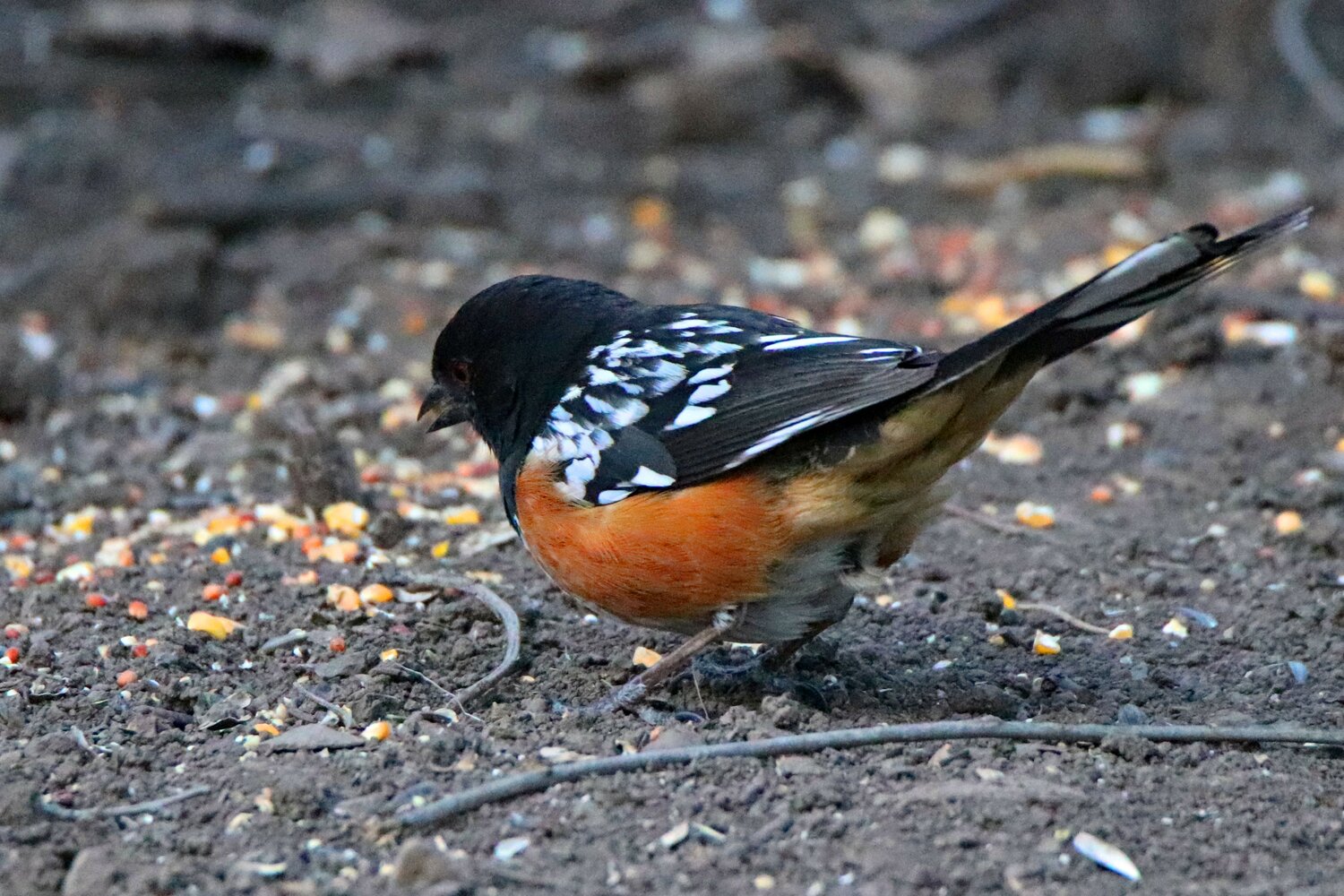
This week’s Bird of the Week, compliments of the Weminuche Audubon Society and Audubon Rockies, is the spotted towhee.
If your yard has brushy, shrubby areas with plenty of leaf litter, this large, colorful sparrow may be hiding there. Leaf litter provides food, water, shelter and winter warmth to insects, which are important sources of food for this and other birds in spring and summer. If you locate seed feeders in protected spaces, you may find these towhees eating spilled seed on the ground underneath. Seeds, berries and acorns are important foods most of the year.
The occurrence of spotted towhees is widespread in the West, where they usually keep a low profile out of sight. The noise from their characteristic double-scratch feeding style, which employs a two-footed, backward, scratching hop in the leaves, may give away their presence in a thicket. Or, you may hear them scolding with a cat-like mew call emanating from deep within the shrubs.
Early in the breeding season, which may begin in February, males spend their mornings perched and singing to attract a mate. They may spend between 70 percent and 90 percent of the morning singing away a trilled song until a pair bond is formed. Pairs are monogamous and territorial, defending a nest site hidden on the ground or low in a shrub.
The male spotted towhee has black upperparts and throat, a thick bill and red eyes. His back and wings are spotted in white and his long, black tail has white outer edges. Rufous-colored flanks set off his white belly. Females have a similar color pattern, with the black parts being browner. Juveniles are brownish and heavily streaked.
The scientific name of the spotted towhee, Pipilo maculatus, translates from Latin as spotted chirper. The common “towhee” name originated from the call of the similar looking Eastern towhee, which some hear as “drink your tea.” Similarities between Eastern and spotted towhees at one time placed them together as the rufous-sided towhee. Other towhee species in the U.S. include the California towhee in coastal areas, the southwest desert Abert’s and canyon towhees, and the green-tailed towhee, a summer breeder in our area.
Providing habitat for spotted towhees is one reason we are encouraged to “leave the leaves” that fall from deciduous trees by the Washington Department of Fish and Wildlife.
For information on events, visit www.weminucheaudubon.org and www.facebook.com/weminucheaudubon/.
Photo courtesy Charles Martinez


 >
>