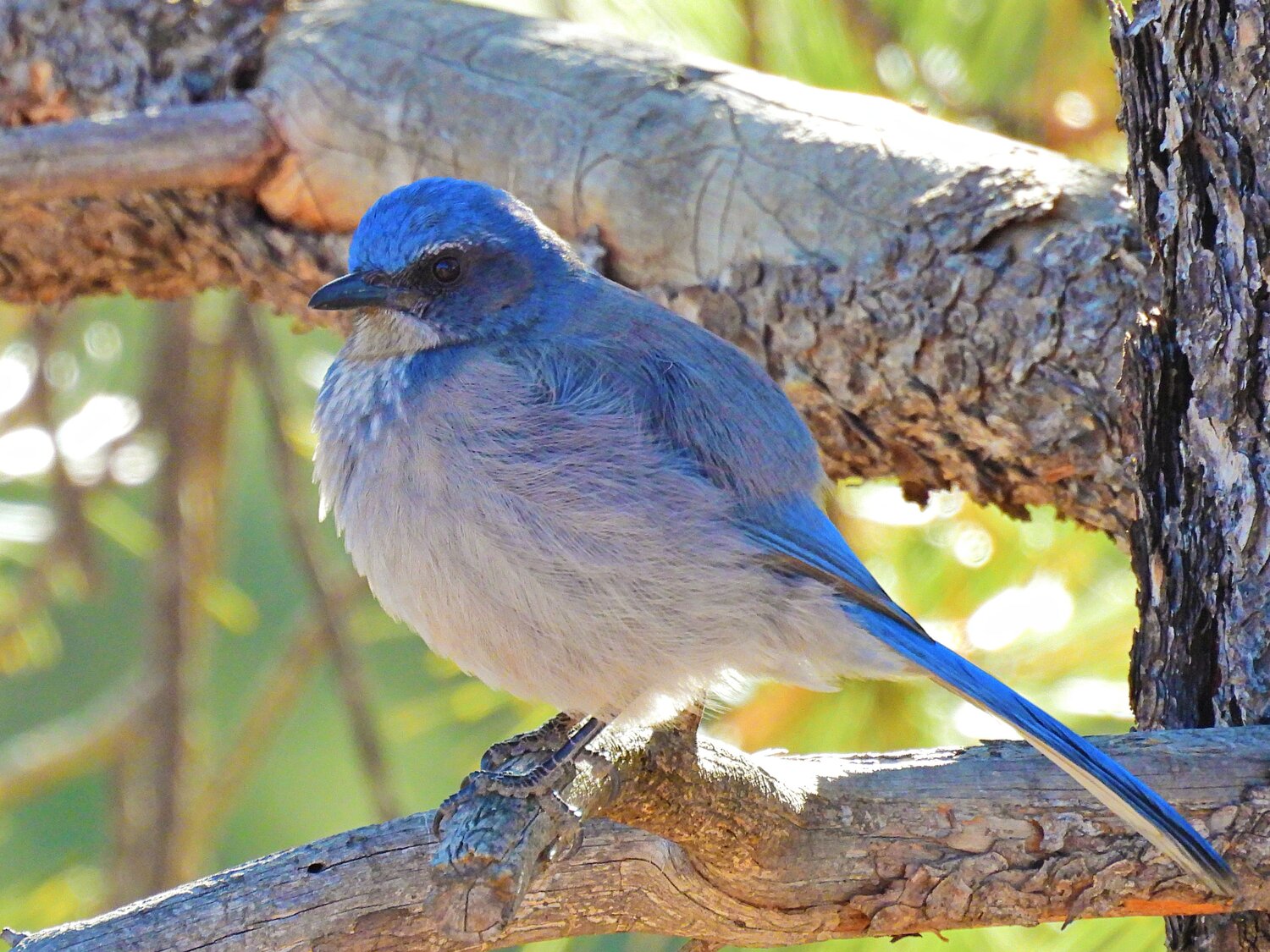
This week’s Bird of the Week, compliments of the Weminuche Audubon Society and Audubon Rockies, is the Woodhouse’s scrub-jay.
This is one of the birds that adds a splash of blue to our compliment of winter birds. Its rounded, crestless head quickly distinguishes it from the black-crested Steller’s jay, our other common blue-colored jay. The Woodhouse’s is light blue and gray above, and has a whitish throat and gray belly. It has a long body and tail and a white strip above the eyes. Its gray and white markings separate it from the all-blue pinyon jay.
Of the four species of scrub-jays, the Woodhouse’s is the one found in the interior western part of North America, occupying parts of Nevada, Utah, the western halves of Colorado and New Mexico and down into Mexico. They primarily inhabit pinyon-juniper and oak-pinyon forests like those found in the southern parts of Archuleta County, but they also venture into our higher pine-oak woodlands and yards.
Like other members of the Corvid family of birds, this scrub-jay is described as vocal, inquisitive and assertive. In summer it eats mostly insects and fruits, but switches to a vegetarian diet in fall and winter, which includes pine nuts, juniper berries and grass seeds. Its fairly thin, pointed bill is designed to extract seeds from the cones of ponderosa and pinyon pines.
To carry it through the winter months, a scrub-jay caches food in hundreds of hiding places within its territory by poking shallow holes in the ground and covering the seed with dirt and leaves. One bird may store up to 6,000 pinyon seeds in a season. The jay is secretive when hiding food, first looking around to see if anyone is watching and moving its store to another spot if it is observed.
At seed feeders, scrub-jays toss anything but sunflower seeds in good condition to the ground. Turkeys come running to grab what is discarded when a scrub jay lands to stuff its mouth full of food to bury.
These birds are important agents of seed dispersal for trees whose seeds are too heavy to be carried by the wind.
For information on events, visit www.weminucheaudubon.org and www.facebook.com/weminucheaudubon/.


 >
>