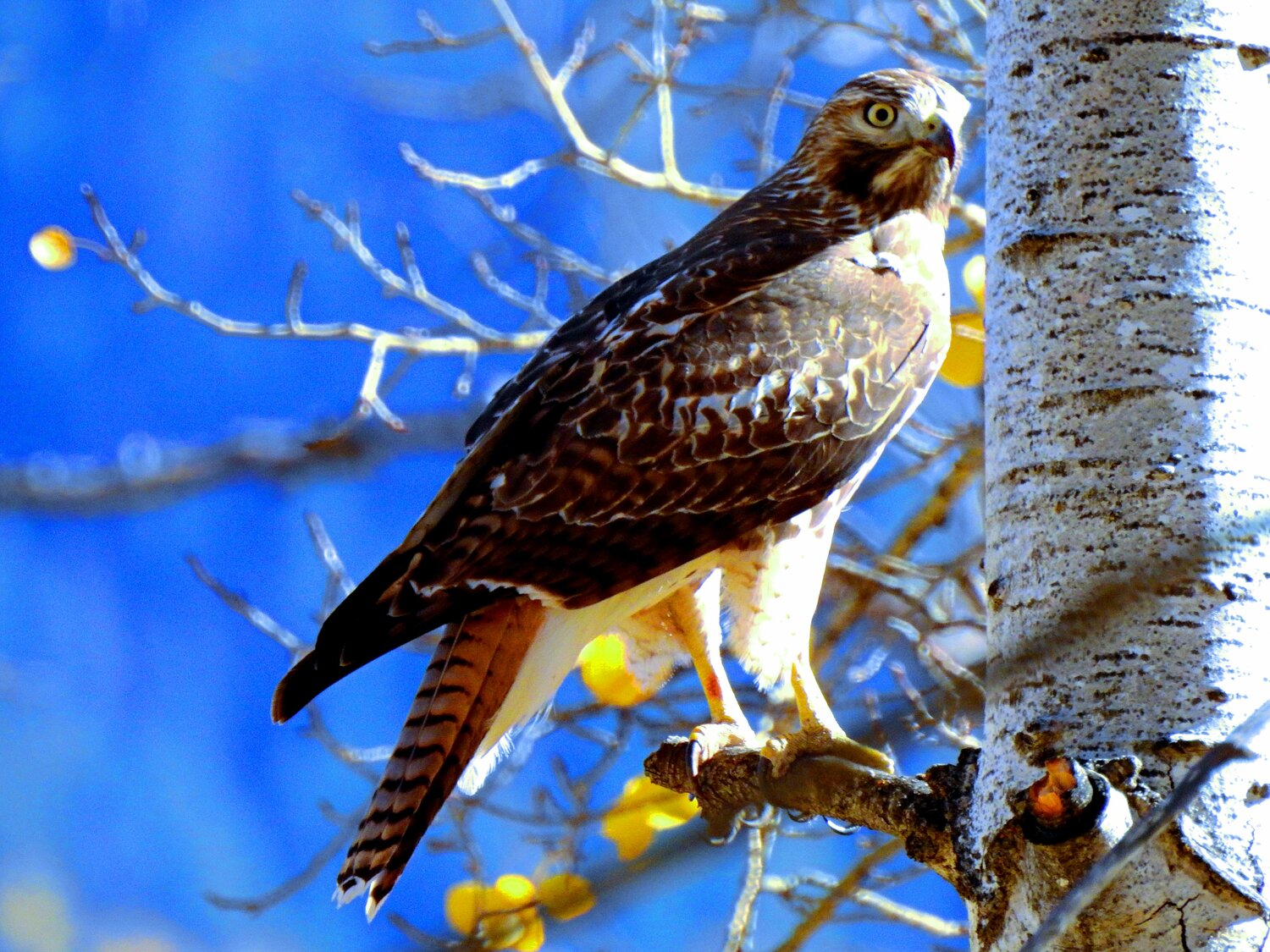
This week’s Bird of the Week, compliments of the Weminuche Audubon Society and Audubon Rockies, is the red-tailed hawk.
No other bird of prey graces us with regular occurrences in the Four Corners more than the red-tailed hawk. With a wingspan often exceeding 4 feet; long, rounded wings; and a wide tail, this species can cover a lot of ground with little exertion. Forming long-term pair bonds with mates, a pair will typically share a territory of approximately up to 2 square miles. Their prey base consists of 85 percent mammals, consisting largely of meadow voles, wood rats, mice, cottontail rabbits, jackrabbits, ground squirrels, prairie dogs and even carrion. Red-tailed hawks also enjoy a good snake or bird, when they can catch them.
In the Four Corners region, birds tend to be year-round residents, whereas individuals at latitudes further north may migrate to make ends meet. Plumage can vary across regions. A few key field marks to note for the most ubiquitous plumage in this region (light morph) are the discernible brown belly band that divides the lighter colored breast and belly, the dark leading edge of the wing (patagium) when viewed from below, and the copper-colored red tail feathers. Juvenile birds exhibit more brownish tails and often have very dark, nearly blackish, beaks. When viewed from the backside, collapsed wings will often show a white “V.” A rarer plumage variation in our region is the Harlan’s red-tailed hawk, which can look almost solidly brown.
An adaptable bird, this species frequents open country, where visibility for predation is key. Look for birds on such perches as tall trees and telephone poles. Nesting season can run from early February through late spring with courtship behavior beginning in January. So, if you witness a pair playing together, involving steep-angled flight stunts, extended legs or even displays involving locking talons, then chances are that there may be nest construction or rehabilitation happening in the same region. Christmas Bird Count participants detected 38 red-tailed hawks during the December 2025 count.
A somewhat rare success story among fellow bird populations, this species has shown increases of more than 1 percent per year since the late 1960s. That said, they still struggle with modern development and habitat loss, energy infrastructure and lead poisoning. Visit peregrinefund.org to support the protection and habitat of red-tailed hawks and other raptors.
For information on events, visit www.weminucheaudubon.org and www.facebook.com/weminucheaudubon/.
Photo courtesy Charles Martinez


 >
>