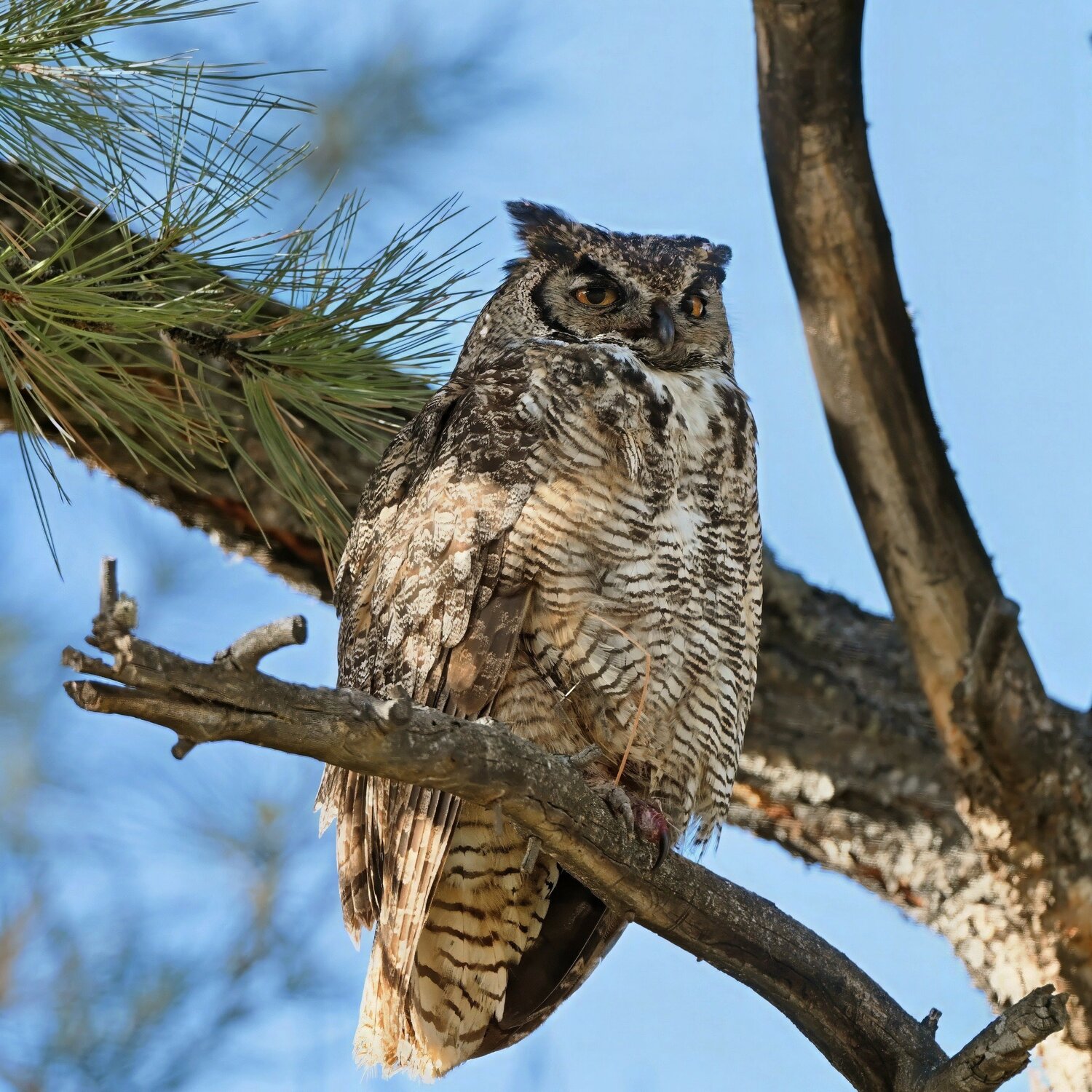
This week’s Bird of the Week, compliments of the Weminuche Audubon Society and Audubon Rockies, is the great horned owl.
Renowned ornithologist and author Scott Weidensaul referenced the widespread occurrence of this owl when he remarked that it is easier to list where they are not found than where they are. They are resident birds living in a wide range of habitat types in most of North America and much of South America.
Despite living among us, great horned owls are notoriously difficult to spot. Both sexes of these large owls are camouflaged in colors of brown, cinnamon and gray, and have barring on the breast. Their cryptic coloration does not hide them from their crow enemies, however, and pinpointing the riotous calls of mobbing crows may reveal a roosting owl.
Great horned owls are one of the earliest breeding raptors in North America and courtship may begin in autumn. They are one of the few owls that hoot, and an individual can be identified by the number of hoots and intervals between them in its call. In fall and in winter before egg laying, a mated pair defends their territory in duets of alternating hoots.
Females lay eggs between December and January, often reusing nests of red-tailed hawks, but also nesting in caves, on cliffs or on the rafters in old buildings. Fledgling great horneds learn to hunt for themselves while remaining in their parents’ territory until the following autumn.
This adaptable predator eats what is available, from tiny rodents up to mammals larger than itself. Its large yellow eyes with pupils that open wide are adapted for excellent night vision. It is able to swivel its head more than 180 degrees to take in the circle of its surroundings, scanning for prey from a perch before swooping down in silent flight in pursuit. Remarkable hearing allows the owl to locate a mouse by the rustle of grass.
Great horned owls are nocturnal, doing most hunting in the hours around dusk and before dawn, but they will also hunt in daylight. The owl in this photo was observed guarding a prairie dog in its talons from a hawk’s attempts to steal it away. Unintended poisoning from the ingestion of rodenticides eaten by their prey is a preventable problem for these and for other birds that hunt rodents.
For information on events, visit www.weminucheaudubon.org and www.facebook.com/weminucheaudubon/.


 >
>