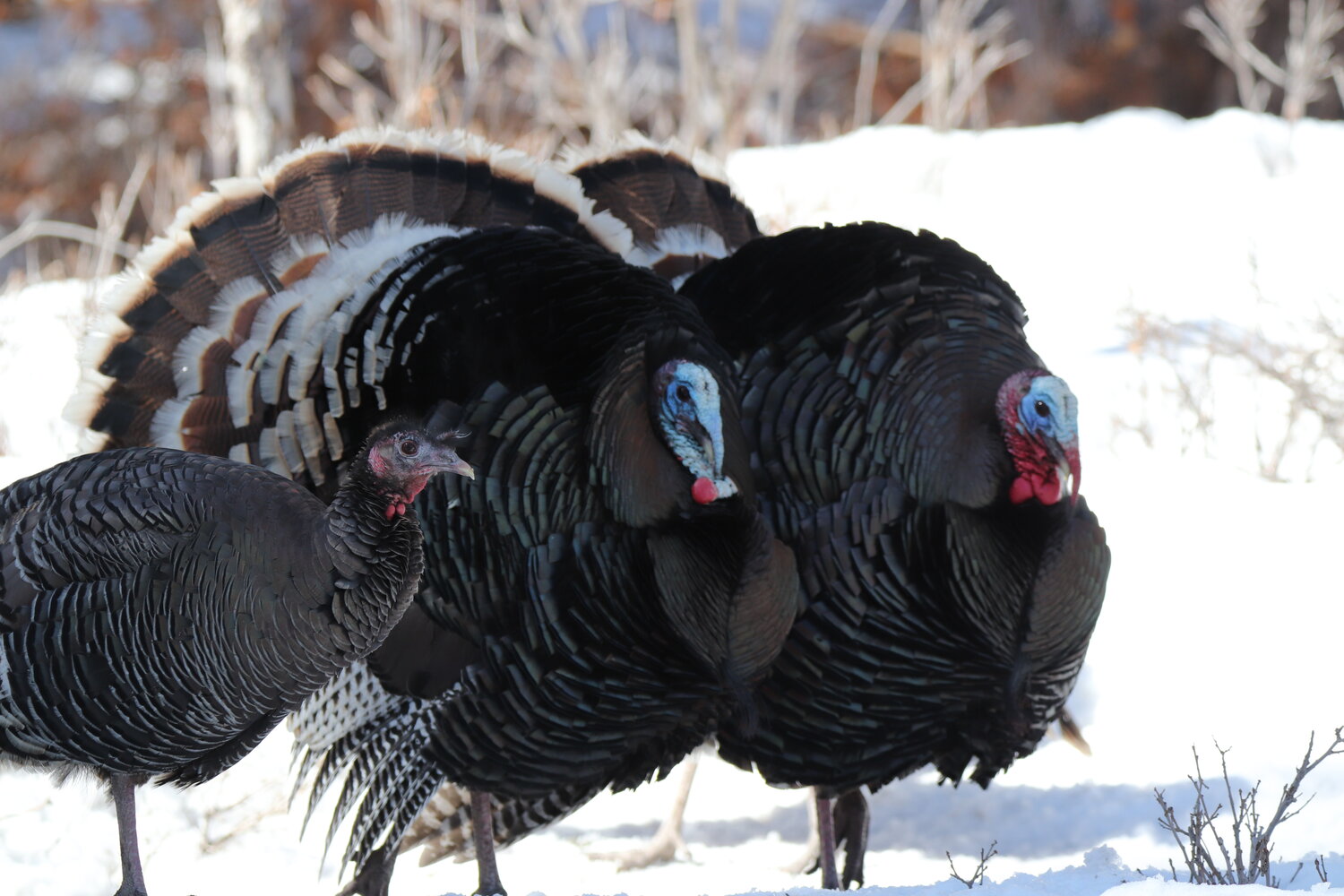
This week’s Bird of the Week, compliments of the Weminuche Audubon Society and Audubon Rockies, is the wild turkey.
Wild turkeys have come to be the symbol of a holiday when we take time to remind ourselves of all that we have to be thankful for. They are native to North America, where fossil records have dated their occurrence for more than 5 million years, but, by 1930, logging, agriculture and overhunting in the United States had pushed the wild turkey to the brink of extinction. Successful management actions included regulating hunting, and catching wild birds and reintroducing them in places where they had disappeared. Now they are found in every state except Alaska.
Wild turkeys live in open forests interspersed with clearings, usually those with some kind of oak. They move in flocks, foraging on the ground for hours and miles every day for acorns, leaves, seeds, grains, berries, buds, grass stems, roots and bulbs, and, in summer, snails, beetles and other insects. With strong, clawed feet they scratch the dirt and dig through the leaves to uncover any morsel of hidden food.
Turkeys mostly walk, but can also fly short distances at speeds up to 55 mph and run up to 25 mph. They can even swim if they have to. At sundown, flock members fly one by one up into trees to roost, murmuring to each other and taking some time to settle. Individuals may jostle for the highest spot and for one farthest from the trunk for safety from nighttime predators.
These social birds call to each other and seem distressed if separated from their flock. A dominant male may breed with several females, but provides no parental care. In his spring courtship dance display, he gobbles, puffs his feathers and spreads his tail, rattles his wing feathers, hums and struts to entice a female. Fleshy parts called snoods, caruncles and wattles turn bright red and blue. Outside breeding season, males form same-sex flocks where the hierarchy is constantly challenged and fluid, and females and young band together separately.
Today, turkeys have adapted well, some would say too well, to life in urban areas, where they find spilled birdseed and garden treats, lawns to forage in, shrubs to nest under and trees for roosting. Their antics include chasing people, attacking their reflections in vehicles, tearing up gardens and pooping on the deck.
For information on events, visit www.weminucheaudubon.org and www.facebook.com/weminucheaudubon/.
Photo courtesy Charles Martinez


 >
>