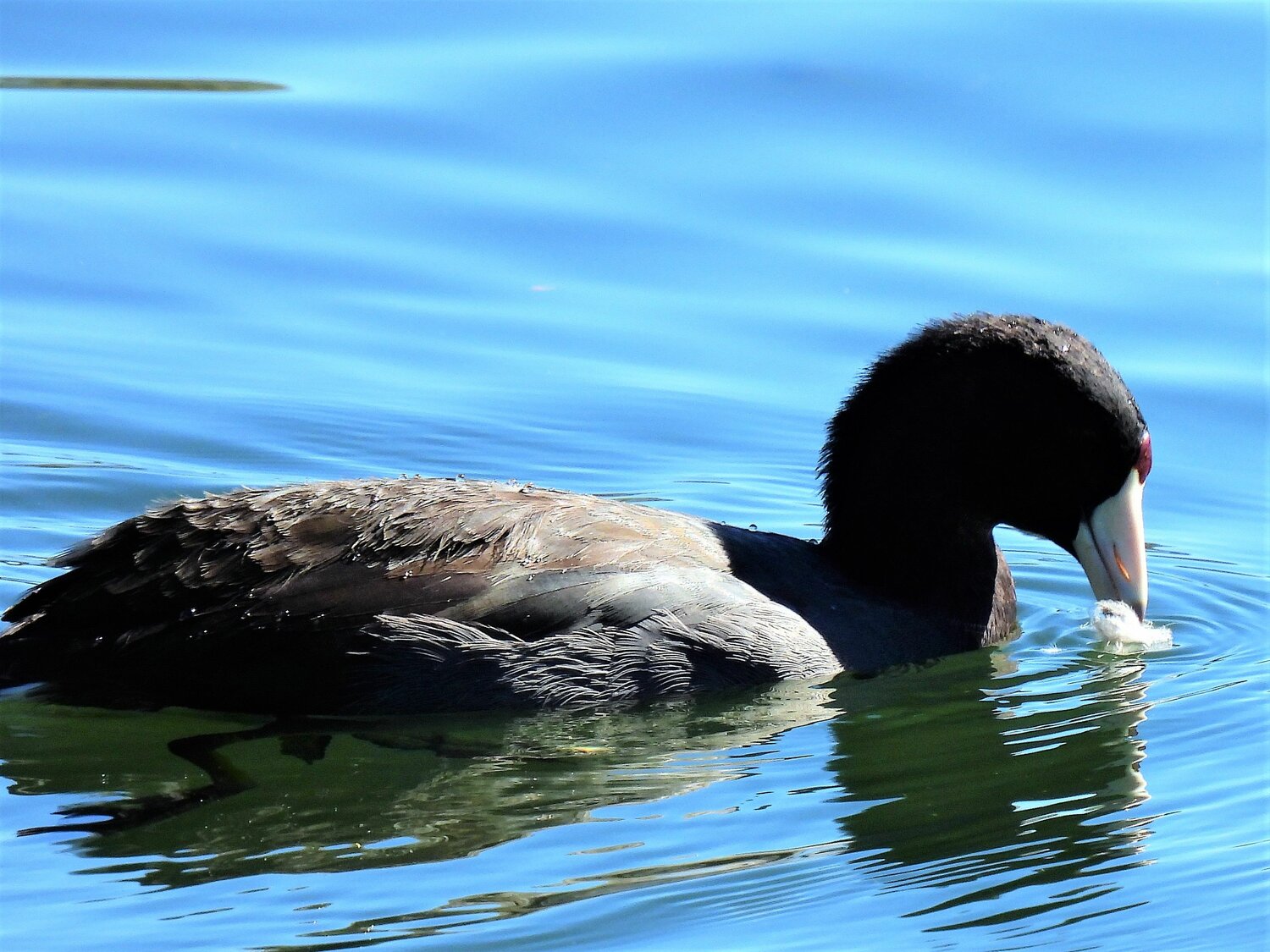
This week’s Bird of the Week, compliments of the Weminuche Audubon Society and Audubon Rockies, is the American coot.
Although it spends a lot of time in their company, this common waterbird is not a duck. Instead it is a member of the rail family of birds, which includes the sora and Virginia rail, much smaller birds that pop in and out of the vegetation at the edge of a marsh.
Colored dark gray to black, the American coot appears plump and chicken-like. Its white beak transitions to a frontal face shield with a red tip. Fledgling coots seen in spring have colorful red skin on their heads and orange-tipped black down. Noisy flocks communicate in cackling, grunting and croaking calls.
Adaptations in the over-sized feet of American coots allow them to maneuver well both on land and in water. Each of their long, greenish toes is encased in two to three fleshy lobes that help push them through the water like webbing on the foot of a duck does. The lobes fold back when the foot is lifted, providing cushioning and mobility on mud, grass and ice.
These long toes can inflict some damage when males lean back on the water and claw at each other with their feet in territorial fights. With short, stubby wings and short tails, what coots are not adept at is flight. Here their lobed feet assist them in running across the water’s surface while flapping their wings to get airborne.
On the water, American coots mainly eat the stems, leaves and seeds of aquatic plants and algae. They dive or dabble for food, depending on the water’s depth. They are often observed to be the victims of wigeons and gadwalls that wait at the surface to grab the coot’s food out of its mouth. On land, coots will eat terrestrial plants, grains, insects and other invertebrates, and small vertebrates.
Especially in winter, coots gather in massive mixed flocks with other waterfowl. In fall, more than 800 at a time have been counted at Echo Reservoir and 300 at Lake Capote. It is one of the birds that we expect to tally in the Christmas Bird Count as long as there are areas of open water in December.
For information on events, visit www.weminucheaudubon.org and www.facebook.com/weminucheaudubon/.


 >
>