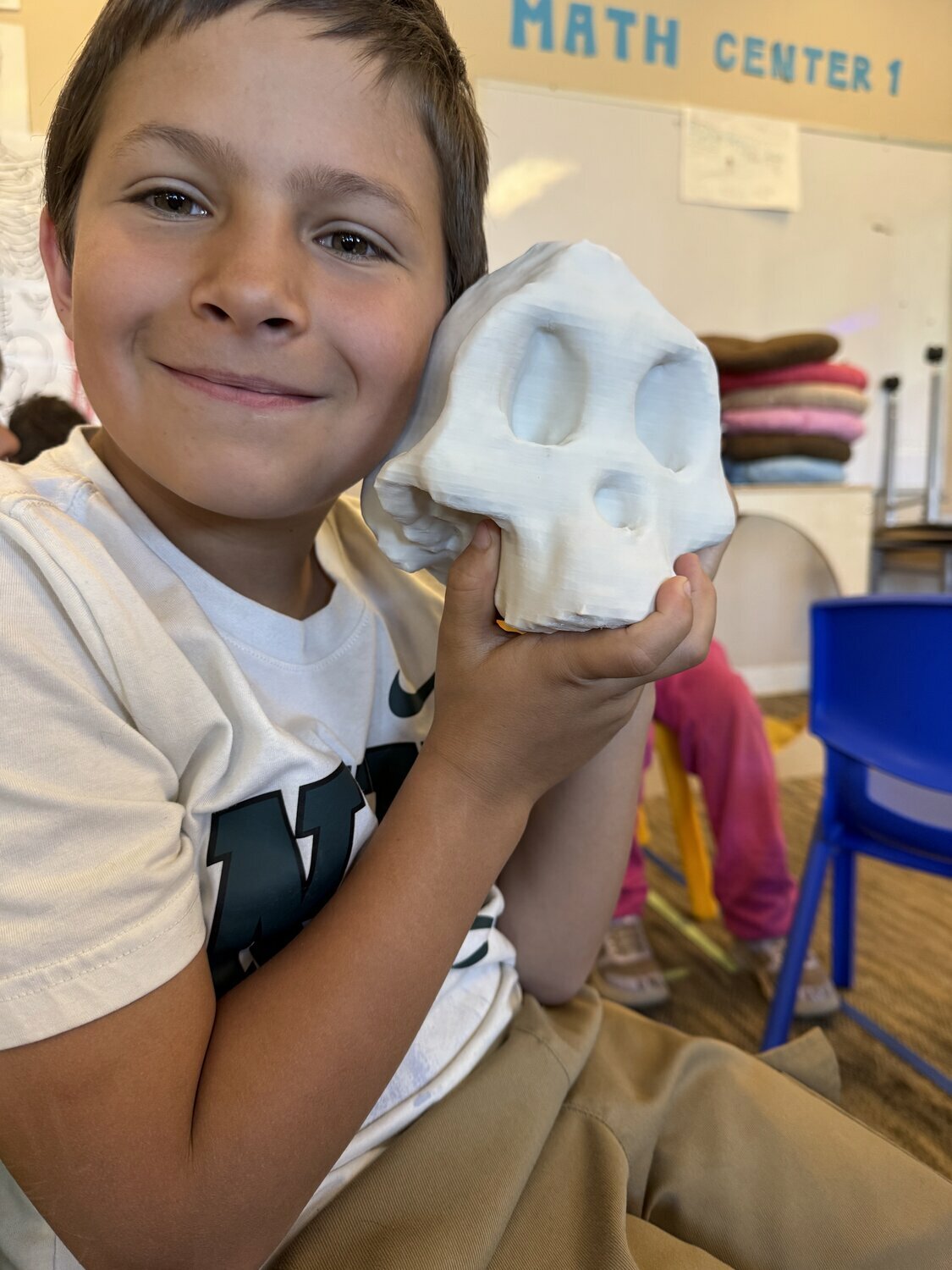
While most second-graders spend their days learning about the present, the students at Pagosa Peak Open School (PPOS) are currently living 3.2 million years in the past.
As part of an immersive project on fossils and human origins, the class received a visit last week from a world-renowned expert: Dr. John Kappelman.
Kappelman is a distinguished paleoanthropologist known for his extensive work with “Lucy,” the famous Australopithecus afarensis fossil discovered in Ethiopia. His visit provided a rare opportunity for students to connect their classroom work with the front lines of scientific discovery.
The project is more than just reading from textbooks. Using technology resources, the second-grade class has been 3-D printing a full-scale model of Lucy’s skeletal remains. This process allows students to handle replicas of the bones, examining the same structures that scientists study to understand how early humans walked and lived.
“Dr. Kappelman shared that there were 3-D files of Lucy, and that inspired me to not only request the files for our class, but also raise money through Donors Choose to purchase a 3-D printer capable of printing the files,” said second-grade teacher Cyndi Figaro. “I knew 3-D replicas would add to our learning.”
To understand how Lucy’s size compared to their own, students engaged in a “Gait vs. Height” study. By measuring their own stride (gait) and comparing it to their height, students applied mathematical ratios to Lucy’s fossilized footprints and limb bones. This hands-on approach allowed the young scientists to estimate Lucy’s stature — roughly 3.5 feet tall — bringing a legendary figure down to a relatable size.
“We were focused on ‘measuring’ during math, so that was perfect for tying all of our lessons together,” Figaro said.
The visit highlights PPOS’s commitment to bringing experts into the classroom and fostering a environment where every student, regardless of their starting point, can engage with high-level math and scientific concepts.
As the 3-D printer finishes the final pieces of Lucy’s skeleton, the second-graders aren’t just looking at old bones — they are looking at the foundation of human history, guided by the very experts who helped write it.
During Kappelman’s visit, students were able to ask questions not only about his work with Lucy, but as a paleontologist and geologist.
Students asked questions like, “Why are Lucy’s hands and feet missing?” and “What’s your favorite dinosaur?”
Kappelman shared about our local Pagosa geology and opportunities for fossil hunting, and brought in some replicas as well as real fossils.
“When we first started this project I just thought fossils were dinosaurs,” said second-grader Avery. “But it turns out fossils can be plants, footsteps, humans and imprints of things. And it is so cool that we have a real live paleontologist who worked with Lucy. I like this project because we get real live paleontologists to visit and we are excited to learn from him and show him what we know about Lucy and fossils.”
For more information about PPOS, visit pagosapeakopenschool.org.


 >
>